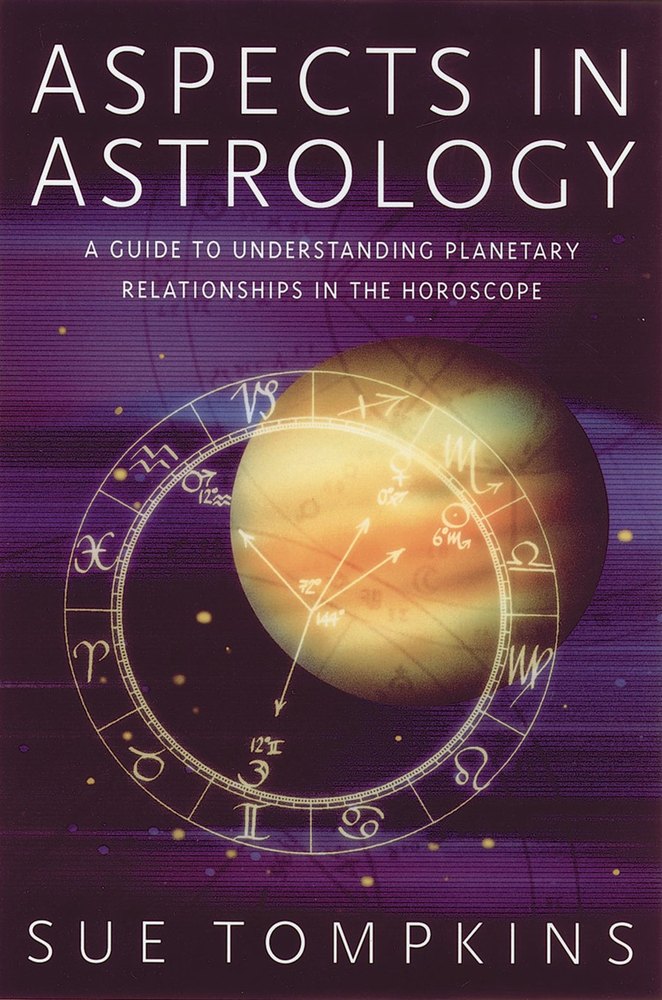
Aspects in Astrology
Sue Tompkins
What brings a chart to life is the relationship between the planets.
When Two Planets Are Joined
Someone merely disagrees with one of your opinions, and you feel that it is you as a person who has been rejected. When Sue Tompkins writes about the Sun–Mercury conjunction in Aspects in Astrology, this is the person she describes. The Sun stands for how a person identifies himself, Mercury governs ideas and the words we speak, and since the two are never more than 28 degrees apart in the sky, the only aspect they can form in a birth chart is the conjunction. People with this conjunction have put their “I” into their opinions, as if to say, “I am what I say, I am what I think.” At its best, such a person wants to become an authority in some field on genuine merit, and is someone who can think independently. The difficulty lies in the same place: he does not easily see that other people's views may be just as valid, and when someone disagrees, he takes it as aimed at him personally.
Bring a third planet to the same conjunction and the meaning changes. If Saturn squares it, this person is actually very unsure of his own ideas, and the less sure he is, the more he wants what he says to be taken seriously. Relationships like this are what Tompkins's book is about. When two planets form a certain angle in the chart, the parts of life each one stands for are joined and act on each other. Signs and houses describe where a planet is and in what manner it expresses itself; aspects describe how planets get along with one another. In her introduction she describes aspects this way:
the energy that transforms the horoscope from the description of a lifeless puppet into something symbolising an alive and vital human being
In other words, aspects describe the drama actually being played out in a chart; a person's conflicts and joys are all here. She also sees aspects as the raw material each of us uses to build a life. Yet many students of astrology know the experience: they can work out a planet's sign, its house and the houses it rules, and put these together, but as soon as they see it in aspect to other planets, they do not know where to begin. Tompkins says this is not surprising. Reading aspect combinations is complicated by nature, and even the most experienced astrologers do not find it easy.
First published in 1989 and reissued in 2002, the book is in three parts. Part One covers the principles of reading aspects, starting with the ten planets, then how aspects are calculated, what each aspect means, how to approach them in actual chart reading, and how the modes and elements of the signs affect aspects. Part Two she calls “A Planetary Cookbook”: the ten planets are paired off and more than forty combinations are discussed pair by pair. Part Three deals with the four angles, the Ascendant, Descendant, Midheaven and IC, and with planets close to them. She explains in the introduction that a book written item by item like this inevitably takes a factor out of the whole chart to look at on its own, and has its limits, but interpretation has to start somewhere.
No More Good and Bad
Tompkins began studying astrology in the seventies. After her training, she began seeing clients and gradually found that what mattered most in a chart, and most needed explaining, were the aspects, yet there was little contemporary material on them. There were good books, of course. Charles Carter's Astrological Aspects is a classic of the field, but somewhat dated, and it does not cover Pluto. Stephen Arroyo had written on the outer planets, Liz Greene on the outer planets and Saturn, and Bill Tierney's Dynamics of Aspect Analysis dealt specifically with aspect patterns, so she does not say much more about aspect patterns. She wrote this book because she herself needed to know more, and once she began teaching, she found that her students did too. Her method was empirical research she had quietly carried out on her own.
Older astrology divided the major aspects into benefic and malefic. By the time she wrote this book, newer thinking already held that this division was at best oversimplified and at worst nonsense. The common practice had become to classify aspects by what number the circle is divided by: those from division by two and its multiples, such as the opposition and the square, are hard aspects, while those from division by three and its multiples, the trine and the sextile, are soft. Tompkins stands on this side. The same goes for the planets: she dislikes the terms benefic and malefic, because all energies are by nature beneficial and indispensable, and go wrong only when badly handled.
She gives the example of a woman with Venus, Saturn and Pluto in a grand trine in water signs, who linked love with denial, fear, scarcity and power. Because these planets formed trines, the link ran smoothly in her, and she never questioned it. She kept her marriage going all her life, was very hard on her husband and far too strict with her children, always saying it was for their own good, because she loved them. Her child, with a hard aspect between Venus and Saturn, felt unloved. Tompkins says that if these planets had formed hard aspects, the woman would have been more likely to doubt herself, and things would have been easier to change. So she writes:
We do enjoy our trines but they are not necessarily ‘good news’ any more than squares are necessarily ‘bad news’.
Good or bad depends on where one stands to look, and on which kind of energy the situation calls for at the time. In reading aspects she also borrows two things from earlier thinkers. Jung said that rather than people having complexes, complexes have people, and Tompkins maps aspect combinations onto what psychology calls complexes. John Addey and Charles Harvey held that the meaning of an aspect comes at least partly from the number by which the circle is divided, so when she discusses the conjunction, opposition, trine and square, she always starts from that number.
The Person Behind the Aspect
For almost every pair of planets, the book comes back to what kind of father or mother the person met as a child. Yet Tompkins does not treat childhood as the cause of everything that follows. She quotes the astrologer Eve Jackson: early experiences and later ones alike are “embraced in a symbolism mapped before either occurrence”. That is, a person is born inclined to react in certain ways and tends to draw certain experiences to himself; what matters is how he experiences and digests what has happened.
This is how she looks at people when discussing aspects between the Moon and Venus. People with this aspect carry within them the image of a mother who loves them unconditionally, an image often inherited from the mother herself and one no one in real life could live up to. She also observes that people with hard aspects between the Moon and Venus often felt unloved early in life, even abandoned, but she points out at the same time that real abandonment rarely comes from these two planets alone; usually heavier planets are also involved. Someone who has always felt that their mother did not love them enough may realize, reading this, that part of that lack comes from an inner picture no one could match.
She looks at childhood to help people understand why they made the “choices” they did. Through the chart, a person can see how early wounds and joys have carried through to the present, and she goes on to write:
In gaining this greater awareness we can increase our ability to exercise free choice in the future.
So she does not treat her own descriptions as verdicts either. Where she is unsure, she says plainly that she can neither confirm nor deny. On the semi-square, she admits she is not entirely clear about its exact difference from the square; on Mercury and Venus, she says outright that this is a pair she does not know well. Many of her examples come from people she knows, from the consulting room and from the classroom, and where she is speculating, she marks it as speculation.
What Comes Easily and Where You Hit the Wall
The gift a trine gives is often the very thing its owner is least able to recognize. The two planets of a trine belong to the same element and flow with each other, so a trine describes what you find easy and are glad to do. Tompkins found that when others point out this gift, we often laugh it off, assuming anyone could learn it, and instead spend most of our lives on things we are not especially good at, things that correspond to our hard aspects. The two planets of a square are always getting in each other's way. A person feels tense, afraid of not being able to cope, and sometimes tries too hard to prove himself, like running into a wall again and again. Yet tension is also a force that makes people act and grow, so handling a square often gets easier with age, and people with no squares in their charts often mature late.
The opposition is about relationship. Of the two ends of an opposition, we usually claim one first; the other is like a stranger standing outside an unopened door, and is often the weightier planet, the one that seems less respectable in our own eyes. The planet pushed away comes back from outside, appearing in our lives through another person or a group, again and again, until we recognize it as part of ourselves too. So if you keep meeting the same kind of person who gives you a headache, by this book's reckoning it is worth asking whether that is a planet of your own you have not yet claimed. When we fall in love, too, we are often meeting some part of our own chart in the other person.
Chapter by Chapter
Chapter 1: The Planets
Before discussing aspects, Tompkins goes through each of the ten planets, focusing on what each brings to another planet it touches. The Sun is the easiest to explain. In the sky the Sun gives light and warmth, and a planet touched by the Sun in the chart is, as it were, illuminated and strengthened. Conversely, when a difficult planet touches the Sun by hard aspect, some of the Sun's strength is diminished; it is a little, she says, like wearing sunglasses on a bright day. The Sun is also where a person wants to be recognized, so she offers some simple images for a few combinations: Sun–Mars says “Notice me, I’m strong”, Sun–Saturn says “Notice me ... people don’t usually”.
Chapter 2: Dividing the Circle and Calculating Aspects
This chapter is marked as written mainly for beginners. All the planets in a chart actually stand at some angle to one another; Tompkins likens them to a dozen or so people seated around an oval table, each able to see the others, only from different angles. The planets are always moving and the angles always changing, and a chart is simply a picture of one frozen moment. She then teaches how to count degrees. In Jane Austen's chart, for example, the Sun is at 25 degrees Sagittarius and the Moon at 15 degrees Libra, 70 degrees apart, which counts as a quintile, while the Sun and Mercury are 19 degrees apart and form no aspect.
Chapter 3: The Meaning of Aspects
This chapter goes through the aspects one by one, and the conjunction gets the fullest treatment. The conjunction divides the circle by one, and its core is union: the energies of the two planets blend and always act together. Tompkins says that two planets in exact conjunction are like two bells struck at once, hard to tell apart, so the person often cannot see that there are two forces at work, while others see it clearly, as with a mark on one's face that one cannot see without a mirror. At the new Moon, when the Sun and Moon are conjunct, the Moon cannot be seen in the sky, and she takes this as a sign that the conjunction carries a blind spot. People with many conjunctions are strongly self-driven, need less confirmation from others, and have less self-doubt. The difficulty is having no mirror to see themselves in, which she likens to a painter setting out to paint a self-portrait without ever having seen her own face in a mirror or a photograph.
When she reaches the 150-degree quincunx, her tone shifts. Squares and oppositions speak of the major conflicts of a life; this aspect is more like an extra irritation. Someone's love life is in crisis and their job is about to go, and on coming home they see a kitchen that should have been redone long ago, and one glance makes their mood worse: this aspect operates at the level of that kitchen. It describes friction rather than conflict, which she likens to a grain of sand in a shoe; shift your foot a little and it is not so bad.
Chapter 4: Interpreting Aspects in Practise
When you first start reading aspects, Tompkins suggests not fretting over which aspect it is, but practicing putting the symbolism of the two planets together, because the same pair of planets is concerned with much the same things whatever aspect they form, only expressed differently. She likes an old method, listing keywords. Take Saturn and Uranus: on the left write words for Saturn, old, control, brakes, fear, tradition; on the right, words for Uranus, new, rebellion, truth, reform, sudden. Then put the two sides together into phrases, and you get cautious reform, fear of change, a break with authority, an unusual father. When you are stuck on an aspect, this method is especially useful.
She warns at the same time that the descriptions in Part Two are really caricatures, often making real life look worse than it is, and should be read more lightly for trines and sextiles. Knowing how someone will act is not enough; she wants the reader to go on to ask why he acts that way, what the purpose of the aspect is, and how else it might be used.
Chapter 5: Qualities, Elements and Signs in Aspect
This chapter comes in from another angle, looking at how signs get along with one another. People with many squares and oppositions in the fixed signs are reliable and steady, and the problem with the fixed signs, Tompkins says, is attachment. When Leo opposes Aquarius, Leo says, “I love you, I am proud of you, you are mine”; Aquarius says, “Because I love you I will set you free.”
In discussing air trines, she tells of a student from her early days of teaching. This student came every week and sat in the front row, apparently very interested, but never took notes and never seemed to make progress; she bought lots of books but only leafed through them. For a while Tompkins suspected she herself was boring. Later she learned that the student had a grand trine in air and attended astrology classes at several places around town, behaving the same way at all of them, because what she enjoyed was the setting of learning and the discussion itself.
Part Two, Chapters 6 to 13: A Planetary Cookbook
Part Two is the thickest part of the book, running from the aspects of the Sun to the aspects of Saturn. Each pair opens with a line of keywords, Tompkins's shorthand, then describes what people with the combination are like, then what kind of father or mother they met as children, followed by suitable work and celebrity charts, and often ends with the best use for the energy. She believes an aspect needs a legitimate outlet. Sun–Mars, for example, is at its best when there is something worth fighting for; with no outlet, it easily turns into picking fights.
She writes only by planetary combination, not by aspect, with the single exception of the Sun and Moon. Because the lights are so important, she treats their conjunction, opposition, square, and trine and sextile separately. Some combinations she sets side by side: Mercury–Jupiter people know a little about everything, while Mercury–Saturn people would rather specialize, and want a certificate to prove it. Aspects between the outer planets are shared by a whole generation, and she covers them only in a very short chapter, saying that they belong to world history and lie outside the scope of this book.
There is no need to read this part from start to finish; picking one pair to study her way of reading closely is enough. On the Sun and Saturn, she first lays down a principle: whatever planet Saturn touches, the person craves what that planet stands for, because they feel lacking there. The Sun stands for “importance”, so such people very much want to be taken seriously, yet fear inwardly that they are actually of no consequence. She then looks for the source in childhood. Small children naturally take themselves to be the center of the world, but a child with this aspect seldom feels so. His individuality goes unrecognized while he himself is closely watched; the father often has too little time, and the mother takes over the role of disciplinarian, with firm ideas about what the child should become. She also found this aspect often in the charts of comedians, with the conjunction common in those of clowns. A clown wears a mask, which amounts to another layer of defense on top of the skin.
There is a bitter irony in the message of ‘don’t take me seriously’ from the person who takes themselves so very seriously.
She does not stop at the difficulties. People with Sun–Saturn aspects are often too sensible when young and loosen up as they get older, and she suspects that for the average person with this aspect, life really does get better with age.
On the pair of Venus and Neptune, she tells of her own early days as an astrologer. Several Venus–Neptune clients asked her to compare their charts with their partners', and at first she went along with it, until a few more questions revealed that there was no relationship between the two at all; the romance had been imagined out of a few friendly words and a warm smile. She believes this imagining matters in itself and is worth looking at with the client: why this person in particular, and what fantasies has he been made to carry? The direction she gives this aspect is to take the ideal back from other people and look for it in oneself.
Chapter 14: The Ascendant–Midheaven Complex
Part Three covers the four angles. The Ascendant and Descendant always come as a pair, and any planet aspecting one of them also aspects the other. Tompkins borrows Arroyo's idea of seeing the Ascendant as a complex, including the sign on the angle, planets conjunct the angle, planets aspecting it, and the sign, house and aspects of the Ascendant ruler, so she warns that this part is the hardest to write in cookbook fashion and should be used with care. She offers several images for the Ascendant, and the most detailed is skin. Skin protects us, both tough and supple, and the Ascendant should be the same, able to move and to grow. People with Saturn or Pluto conjunct the Ascendant are like someone wearing a mask that is too tight, shut in behind their own image.
She explains the Midheaven through a party. Walking into a room full of strangers, we first appear as our Ascendant; once the conversation gets going, someone always asks, “And what do you do?” She says this question is mostly concerned with your social position and background, the work itself coming second, and that is a Midheaven question.
Chapter 15: Planets and Angles
The last chapter places each of the ten planets on the four angles in turn. People with the Moon conjunct the Descendant have a strong need for relationships that offer care and support, and often find after a few years together that they have “married” someone very like their mother. People with Uranus conjunct the IC sometimes had great upheavals at home early in life, and many have to put down their own roots. She also writes of the advantages of this situation: for such people freedom lies in the foundations themselves, and whatever they do, they need not contend with the pull of the past and family tradition.
How to Read This Book
The forty-odd combinations of Part Two are the most appealing, but turning straight to them makes it easy to take the descriptions as verdicts. Read Chapters 3 and 4 first, to understand the nature of each aspect and the method of reading them, then look for the pairs of planets in your own chart. As you look them up, remember Tompkins's own warnings: the descriptions are caricatures, trines and sextiles should be read more lightly, and an aspect must be set back in the whole chart. Part Three requires an accurate birth time. She is explicit that when the birth time is uncertain, planets conjunct the angles should be treated with caution, because the conjunction may not exist.
The book has its limits too. Written in 1989, it draws its famous examples mostly from Western public figures of that era, many of whom may now be unfamiliar; as you read, watching how she reasons from the chart to the person is more useful than remembering the names. Almost every pair of planets comes back to childhood and parents, sometimes in a way that reads like a fixed script, and she herself says things do not always unfold this way. In a few places the book also links certain aspects with accidents or physical problems, some drawn from earlier writers such as Carter and some from her own observation; she too reminds readers not to frighten themselves over these, and such passages are best read lightly. Aspect patterns she leaves to Tierney's book, and aspects between the outer planets are not developed either, so readers looking for these two things will need other books.
A chart has many aspects, and they do not carry equal weight. In Chapter 4 Tompkins explains how to weigh them: planets close to the four angles, aspects that are nearly exact, and aspects involving the Sun, the Moon, the Ascendant and the Ascendant ruler should all be looked at first. Your Most Important Aspects in Depth reads your own chart and uses this method to pick out the most important few. Each one is read her way too: first what the two planets bring to each other, then whether the relationship is a hard or a soft aspect, because Venus and Saturn in a square and Venus and Saturn in a trine do not look the same in a person. She believes an aspect needs a legitimate outlet, so each one ends with where its energy can be put to use. Planets close to the Ascendant and Midheaven are also read separately in the report. Like the book, it keeps its eye on the relationships between planets; the rest of the chart lies outside what it reads. Tompkins says there is no moment at which one can claim to have understood a chart, or oneself; the most important aspects in your chart are a place you can begin.
 Your Most Important Aspects in DepthSee report · $19