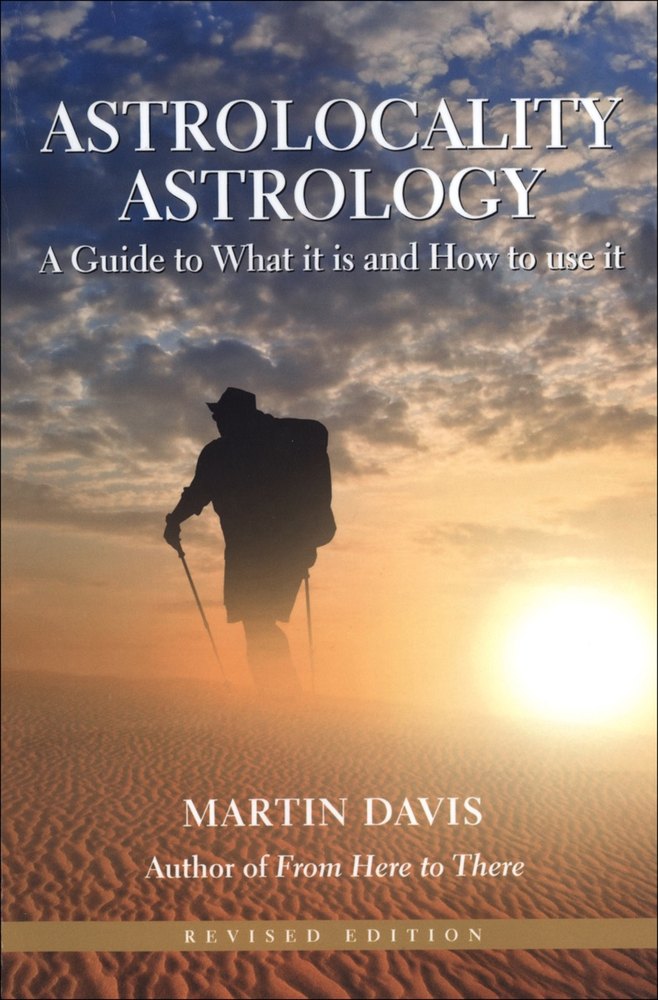
Astrolocality AstrologyA Guide to What It Is and How to Use It
Martin Davis
The birth chart stays the same; move to another place, and a different planet steps to the front.
Moving Is a Transit Too
Some people who go away to study or work find that, though hardly anyone noticed them at home, in a strange city they are often pushed in front of a crowd. Martin Davis ran into this when he was young. In 1963 he went to São Paulo in Brazil to fence foil at the Pan American Games. His team won gold, and though he says he was only a minor player there, the local spectators crowded round him for autographs, carried him off on their shoulders cheering, and wealthy Brazilians offered to pay him to stay and teach fencing. He later said it was the most public praise he had ever received in his life, and most of it undeserved.
Many years later, when he learned astrolocality astrology, he found the reason for that scene. Near São Paulo, the Moon of his birth moment was right on the Midheaven, and Jupiter was only 5 degrees from the Ascendant. Jim Lewis said of this Moon and Jupiter combination that it marks one of the best places of all, where a person is loved and admired.
That is the subject of Astrolocality Astrology: A Guide to What It Is and How to Use It, published in 1999. Davis argues that astrology has always thought in terms of time. The birth chart, transits, progressions and directions all ask when something will happen, and the latitude and longitude of the birthplace are just data entered to cast the chart.
The space factor hasn't played a very big role, and the space factor is really what Astrolocality astrology is about.
From there he reasons onward. Because we can calculate where on earth a planet falls on one of the four angles, a person need not sit and wait for some transit to arrive; moving to another place on earth amounts to creating a transit for oneself in space. People today often change cities for work or for love, so Davis feels astrology should not only say when to move, but also where to go and in which direction.
The book covers two techniques. One is Astro*Carto*Graphy, ACG for short. Wherever on earth a planet is rising, setting, overhead or underfoot, those places are joined into lines; live near a line, and that planet falls on one of the four angles of your chart there. The other is Local Space. You stand at your birthplace, see in which direction each planet lies, and extend a line from there straight toward it. Davis likens the two techniques to the left and right hands of one body. He calls the places where a direction line crosses an ACG line destiny points, and in the last chapter he adds geodetics, which looks at which sign a piece of land itself carries. He also makes clear that the traditional birth chart remains the foundation of astrology, and that these techniques add a layer on top of it: the same chart, taken to different places, pushes different planets to the front.
Place Used to Be Only for the Ascendant
The introductory comment at the front of the book is by Nicholas Campion, and he opens by asking what happened to space. Everyone who studies astrology is taught that casting a chart takes three pieces of data, time, date and place; yet in contemporary astrology the place is used only to calculate the Ascendant and Midheaven, and once that is done it is never mentioned again. Campion says it was not always so. Babylonian astrologers, for example, noted in which direction of the sky an omen appeared, to judge in which region it would come true.
Two people above all brought place back into personal astrology. ACG was developed by Jim Lewis from the 1970s and made public in 1976; in 1982 he added transits and progressions too, to see when a given place would offer a temporary opening. Lewis died in 1995, and two years later his colleague Kenneth Irving gathered his later work, together with his own insights, into The Psychology of Astro*Carto*Graphy. The first ACG lines Davis used, more than ten years earlier, he had bought from Lewis himself.
Local Space comes from Michael Erlewine. From the idea and the design to the calculating program, he made it all himself, and the name “Local Space” is his too. In the 1970s, before home computers, he worked out Local Space charts on a calculator for himself, his family and his clients, and gradually saw that planets close to due east, due west, due south or due north had an especially strong effect in that place, and that people often travelled or moved in exactly the direction of a particular planet. The biggest move of his own life was from his birthplace, Lancaster, Pennsylvania, to Ann Arbor, Michigan; when he later did the calculation, Ann Arbor lay right in the direction of his natal Jupiter, less than two degrees off.
By the time Davis wrote his book, most people who used these techniques used only one of them. He used the two together. At first he called the crossing of a direction line and an ACG line a bi-paran, and later renamed it a destiny point; both terms first appeared in his article “Local Space Astrology”, published in the November/December 1989 issue of the British Astrological Journal. For the geodetics of the last chapter he used the system usually attributed to Sepharial, and built on it his idea of the Resonant Chart.
This material comes from the astrolocality classes he taught for many years in Britain, as well as in Athens, Dublin, Johannesburg and Moscow, and he wanted to answer directly the questions students most often asked. Davis graduated in engineering from New York University and worked as a quality-control engineer, spending about seventeen years in an office before resigning in Ankara, Turkey, in 1977.
He Found a Trine Again in Scotland
Davis was born in St. Louis, Missouri. In his birth chart Saturn and Venus are 126 degrees apart, a trine. A Local Space chart is measured from a particular spot along the directions of the horizon, and because the plane of reference is different, the angles between planets often differ from those along the ecliptic. Calculated from St. Louis, the two planets are only 88 degrees apart, almost an exact square, and the very wide natal opposition between the Moon and Saturn also tightens considerably here.
He reads this square as his childhood. The tension between his parents took up most of their energy and left little for the children, until they separated and his mother took the children to New York while his father stayed in St. Louis. In the years he grew up on the American East Coast he had plenty of friends, yet always felt lonely; later he went to Britain and Europe. In the small Scottish town of Duns, Saturn and Venus in Local Space returned to a 126-degree trine, and the Moon–Saturn opposition loosened too. He writes:
I regained my birthright (as indicated by my natal chart) to experience Saturn's energies harmoniously, and I did it by changing my earth location!
In his reading, a place either brings forward or pushes down what is already in the birth chart. The trine was always there in his natal chart; St. Louis pressed it into a square, and Scotland gave it back. Conversely, the difficult parts of the birth chart travel with the planets too. Natally his Mars squares his Sun. When he lived in Philadelphia he was on his Sun's MC line, and both his career and his fencing were on the rise, but every step took extra work and extra time. Wherever the Sun line runs, he says, it always carries that Mars square. So he cautions that a Venus line is not necessarily a place of pleasure and beauty; it can also lead to indulgence one later regrets. And a Saturn line is sometimes exactly the place needed to accomplish something difficult.
So if you have been lonely living in a certain city, the question can be put another way: what angle did that planet make to the other planets there, and what was it like in your birth chart to begin with?
Cities You Have Been To, Cities You Will Go To
Before Davis was invited to Miri in Malaysia to do business consulting, he had never even heard of the place. Once there, he unexpectedly felt at home: the food was good, the weather warm, the work went smoothly. He had to interview about 25 employees of a local oil company one by one. They came from very different backgrounds, and he says that with each person he met, he could feel that person's difference in his body. Later he found that his Mercury IC line runs through Brunei, less than 75 miles from Miri. Mercury has to do with business travel and communication, and the IC brings feelings that land directly in the body and go right through to the heart. Together they describe exactly what he experienced in Miri.
Many people have had a city like this, one they never forgot after a single visit, or one they lived in for years without ever really settling. This book offers a way of looking back: in that city, which of your planets came to an angle, or to due east or due west, and what was it like in your birth chart to begin with? Seen this way, the moves and long journeys of the past often turn out to have a reason.
Looking ahead works the same way. When a job in another city is on offer, people usually start by working out the salary and the rent. Reading as this book does, you can ask one more question: once you are there, which planet will be pushed onto an angle, and do you want it to be the theme of your life for the next few years? Even without changing cities, moving to another neighbourhood in the same city brings changes. Davis lived in Philadelphia for twelve years and moved through five neighbourhoods, and each time he moved, his view of his work and of the city changed with it.
Chapter by Chapter
The main text has five chapters. Before them come Campion's introductory comment and Davis's own preface and foreword; after them, an afterword and seven appendices, most of them written by others.
Chapter One: An Introduction; Astro*Carto*Graphy: The Basics; Advanced Astro*Carto*Graphy
The first chapter sets out ACG lines clearly. Every planet leaves lines on the earth where it is rising, setting, overhead and underfoot, forty lines in all for the ten planets. Replace the birth latitude and longitude with those of another place, keep the date and time, and cast a new chart: this is the relocated chart. The planets keep their sign and degree, while the four angles and the houses change. Live near a planet's line, and that planet comes onto an angle in the relocated chart, often becoming the theme of life there.
Lines can also work the other way round. Davis's Venus Descendant line runs right through Paris, and his wife was born in Paris, though the two did not meet there. From this he says that a person need not go to a sensitive place in person to draw its people and events into his life. The chapter has another detail too. A line is the boundary between two houses, so its two sides carry the colour of different houses. East of an MC line, for instance, the ninth house colours things, and matters are often pushed forward by people of every kind working together; west of it, the tenth house colours things, a person must shoulder authority and responsibility alone, and the relationship with one's parents also comes to the surface.
Only one or two planets come onto the angles. When Davis discusses Miri, he goes through every planet in that relocated chart and which house it moves into, because Pottinger and Dobyns had pointed out that the new house positions of all the planets say more about the experience of being there.
Chapter Two: Local Space; Using Local Space Charts, Chart Maps and Maps; Shifting Aspect Patterns
Local Space has to be explained starting from an open field. Stand in a field with nothing in the way and turn slowly around: where sky meets earth there is a circle, with a radius of about seven miles, and the plane extending from your feet to that circle is the basic plane of Local Space. Every planet can be located on this plane by direction and height, with direction measured from due east. Local Space, Davis says, speaks less about future growth and more about what is already there, here and now: the situation a person can feel in the gut on arriving somewhere.
Anna's story comes from this chapter. Anna was thirty-eight, single and living in London. She had met a Brazilian man who was on holiday in England and was going to visit him at his home in Rio. Davis calculated her Local Space chart for Rio, found the Moon exactly due east, and told her that matters such as motherhood, setting up a home and looking after children might come up. When she came back she said it had started on the way there. Several children sitting next to her on the plane were as fair-skinned as she was, and the flight attendants took them for hers and kept coming to ask her when and what to feed them. In Rio her boyfriend had three children; she stayed three weeks and became almost a substitute mother to them, and both he and his mother urged her to stay. Davis says that when you travel toward a place where a planet lies in an exact cardinal direction, the nature of that place begins to show while you are still on the way.
The second half of the chapter is about how aspects change, and the Scotland episode described earlier comes from here.
Chapter Three: Local Space Maps; Destiny Points: Combining ACG and LS Information
Chapter 3 extends direction out into the distance. Extended from the birthplace in the direction of each planet, a line becomes a great circle around the globe. Travel in the direction of a given planet, Davis says, and that planet's energy becomes available to you; it will also bring people and news from that direction to you.
He illustrates this with the aviator Charles Lindbergh. On 20 May 1927 Lindbergh took off from Roosevelt Field in New York and flew solo and non-stop for 33 hours and 29 minutes to Le Bourget airport, north of Paris. Before him, 91 people had attempted to cross the Atlantic, mostly by routes further north or south, and none had done it solo and non-stop. The line extended from his birthplace, Detroit, in the direction of Mars passes over the eastern Atlantic and southern England all the way to Paris, almost matching the route he actually flew. Davis reads it to mean that from the moment Lindbergh was born, this direction toward Paris was bound up with initiative, decisiveness and courage.
Why Paris in particular? Lindbergh's Moon MC line passes near Paris. With the Moon on the Midheaven, a person easily becomes the focus of public attention there, and the Moon also shows that such adoration comes on strongly and fades quickly. But the Moon MC line runs north and south through many places, and the Mars direction line crosses it right near Paris. The direction explains why he went there, the location explains what he would meet once there, and where the two cross, Davis calls it a destiny point. He also cautions that when looking for destiny points, you start from the lines extended from the birthplace, regardless of where the person later lives.
Chapter Four: The Local Space Chart in the Home, Community and Beyond; Special Studies in Local Space
Chapter 4 brings direction back inside your own home. The method is to find true north and the centre of the house on a floor plan of where you live, extend each planet's direction line both ways from the centre, and see which room and which objects they fall on. Davis recommends using the birthplace data, even if you now live far from where you were born, and a birth time accurate to within half an hour. He compares the method with feng shui: feng shui works with principles that apply to everyone, while Local Space adds the individual birth chart.
He tried it on the room he lived in. The room had first been arranged for use and appearance, and only afterwards were the lines laid over it. The Uranus line pointed straight at his computer. The Saturn line fell on a desk whose tray was piled with business that had come looking for him and bills to be paid, a pile he himself called “the mess”. The Venus line had his music collection on one side and the wardrobe of neatly stored clothes on the other. Ralph and Lahni DeAmicis, whom the book quotes, also caution that Local Space on its own is no substitute for sound ergonomic design.
Widen the view to the community, and where the direction lines from home lead also says something about those places. Steve Cozzi found that the direction line from home to the workplace often describes the nature of the job, or your attitude toward work. The last few case studies in this chapter are all chosen as examples that cannot be explained by ACG lines alone and make sense only once Local Space is added.
Chapter Five: Geodetics: The Geodetic World Map; The Geodetic Chart: What It Is and What It Tells Us
Geodetics lays the zodiac out over the earth. Zero Aries is set on the zero meridian at Greenwich, and each degree of the zodiac eastward corresponds to one degree of longitude; the rising sign is then set by latitude. In this way every place has a fixed Midheaven and Ascendant. Because these depend only on latitude and longitude, they are the same for whoever lives there, and they never change. Put the planets of your own birth into this fixed chart, and what you see is how the land treats you.
Fundamentally the geodetic chart tells us what the earth does to us at a given location.
Once again he takes Duns as his example. In the geodetic chart of Duns, his natal Mercury–Saturn opposition falls exactly on the Midheaven and IC, and Pluto sits almost on the Ascendant. With Mercury on the IC, he started an international software sales business from home. With Saturn on the Midheaven, he became an authority in Britain on astrology software and astrolocality, and his reputation came slowly but steadily. With Pluto rising, he was the only American for miles around, so comfortable or not he would be noticed, and what he said would be listened to. He says this is only one piece of the puzzle of why he settled there in particular, not the whole of it.
The chapter also puts forward the idea of resonant locations: places whose geodetic chart has four angles that roughly match the four angles of your birth chart. Davis suggests looking first for places with a similar rising sign, and allowing more leeway on the Midheaven.
Afterword and Appendices
The afterword is short. The greatest difficulty in using astrolocality, Davis says, lies in the person, not in which technique to choose.
Essentially, whenever we arrive at a new place, the one thing that hasn't changed is ourselves!
Whether you are willing to let the energy of a new place influence you consciously, or whether at the first fear you put up a wall inside, this personal responsibility is, in his view, the unspoken premise of using astrolocality well. He draws an analogy with active information in physics: a very weak satellite signal can make a huge oil tanker change course. The signal astrolocality gives is small too, yet it can help a person make the big decision of where to move with a clear head.
Among the seven appendices, Jeff Jawer writes forty interpretations of ACG lines, beginning with the reminder that what matters most in reading a relocated chart is the condition of the planet in the birth chart. Appendix 2 is Davis's own interpretation of the four Local Space directions, also forty passages, written in a very conversational way and often ending by asking where the problem lies. Saturn due east, for instance, may bring some difficulty at first: there is unfinished business to finish and serious thinking to do about what you really need from now on, and work that demands long, serious effort actually gets done there. When he lived in Ankara, Turkey, Saturn was due east; he could not live the single life he wanted, so he turned to research and study, and what he learned in those years became the backbone of the next twenty years of his life.
Angel Thompson's piece on planetary lines inside the home warns against putting the telephone on the Pluto line, or no one will ever call you. The rest are Erlewine's two earliest articles on Local Space, an article by Sean Lovatt on the Local Space chart, a short piece by Davis on two kinds of Pluto placement, and Robert Currey's tribute to Lewis.
How to Read This Book
This book was put together from Davis's classes. His publisher urged him to write it; it is the textbook he had been promising for years. It has nearly a hundred figures, and many passages need to be read alongside them. Davis's own introduction and the section “A Different Perspective” are both short; read them first to understand what the whole book is asking, then read the case studies, Anna in Rio and Lindbergh in Paris, to see how direction lines and destiny points land on a person. Going back to the detail about lines in Chapter 1 will then be much easier.
The book also has parts that have dated or cannot be stated with certainty. It came out in 1999 and uses the software of the day; the publisher brought out a revised and updated edition in 2014. There is no fixed range over which a line works: Lewis sometimes took three or four hundred miles, sometimes as much as seven hundred, and Davis quotes Robert Currey as saying that in the end it is the astrologer's own choice. Using directions at home requires a birth time accurate to within half an hour. Davis also admits that both he and Cozzi went wrong when they used a city's founding time to set directions, because it is hard to say exactly when a city was “born”. The second half of Chapter 5 practises on the charts of nations and natural disasters; that is research at the collective level, and readers interested only in themselves can skip it.
At the end of Chapter 1 Davis tells a story. On a Manhattan street a young man asks an elderly stranger how to get to Carnegie Hall. The old man happens to be a violinist, and replies only, “Practice, son, practice.” Davis uses the story to say that learning astrolocality should begin with your own chart and those of family and friends, checking it against what happened in the places you have been. For most readers, though, there is still a step in between, because where each planet's lines run, and in which direction each planet lies as seen from the birthplace, all have to be calculated first.
Your Astrolocality in Depth has done that calculation for you, and you don't need to fill in the cities yourself; the program chooses them for you from more than forty major cities around the world. It looks among your lines for the kind of destiny point Lindbergh found in Paris, and where it finds one, it states which planet's direction line meets which planet's ACG line, and how far the crossing is from which city. The kind of change Davis found in Scotland, when he got his trine back, is there too: the report picks two major cities people often consider, relocates the whole chart to each, and looks at which planets change house and which pairs of planets grow tighter or looser there. Your birthplace is also read closely: which planets' lines pass nearby, and whether any planet lies due east, due west, due south or due north as seen from there. It also shows you how to lay these directions over the floor plan of your home, to see which part of your home each planet's line crosses.
It reads only the layer of place: in which city and which direction your planets are pushed to the front. What each of these planets governs in your life, and when it comes into play, has to be seen by going back to the whole birth chart and the course of each year. Once you have it, start by comparing it with the cities you have lived in or visited, and see whether what happened there fits the planets the report points to. That is the step Davis started his students on, too.
 Your Astrolocality in DepthSee report · $29