The Astrology of Fate
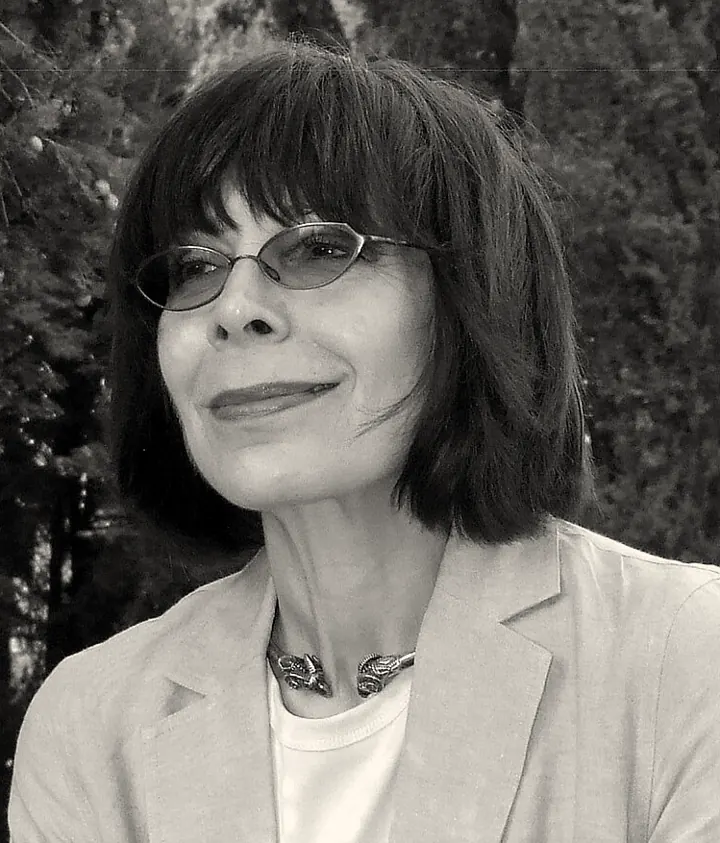
Liz Greene
Once you see clearly the part that is not yours to choose, you become more and more at home in your own chart.
The Portion Allotted to Each
Which family we are born into and what kind of people our parents are, we do not get to choose. Sometimes you work hard to avoid something, and a few years later it comes back in another guise. The Astrology of Fate, which Liz Greene published in 1984, is about this part of life that is not ours to choose: where it falls in the birth chart, and how a person can live with it. Greene trained as a Jungian analyst and has always read charts for people, and most of the book's examples come from her analysands and astrology clients.
Are we fated, or are we free? In the introduction she admits at the outset that she has no answer:
I am inclined, when faced with such an enormity, to feebly answer, Both.
She will not say that everything is already settled, nor that everything can be changed by one's own efforts, because what she meets in the consulting room and in reading charts fits neither view. The Greeks called this part Moira, a word whose original meaning is “allotted portion”: the share that falls to each person and that he cannot pick for himself. Greene makes a point of saying that Moira is not quite the same as predestination as usually understood. She is more like natural justice: everyone is free within their own bounds, and she comes to exact repayment from whoever oversteps the bounds nature has set. The book has three parts. The first is called Moira and deals with Pluto and the family. The second is called Daimon, the god the Greeks believed accompanies a person throughout life, and reads the twelve signs through myth. The third is called Pronoia, a late Greek term for divine purpose, and deals with Jung's synchronicity and the Self.
The book contains the dream of a Capricorn man. Discussing Capricorn, Greene says that the keynote of this sign's life is leaving the mother's embrace, entering the father's world, and accepting the world's rules and limits. In the years this man came for readings, transiting Saturn and Pluto were conjunct, passing together over his natal Ascendant. He was dissatisfied with his work, his marriage, his children and even his own body; everything seemed a trap. He had done very well in the law, yet always felt that this was not his true self, that the real thing was always still to come. He dreamed that he and his wife were locked in a prison whose door stood open, so they could leave at any time, yet both felt they were staying of their own free will; outside the door stood an older woman warder who only watched and did not interfere. Reading the dream, Greene says he was slowly coming to understand that the real thing was everything already present in his life now. To accept what has been allotted to one and give oneself to it wholeheartedly is what she calls a religious attitude.
Psychological understanding does not make the part that is not ours to choose go away; what changes is a person's relationship to it. This is the point Greene returns to again and again throughout the book.
The Subject Colleagues Recoil From
Whenever colleagues talk about the part of life that is not ours to choose, they recoil, even grow angry, astrologers and analysts alike. Greene wanted to understand why, since in her view no modern profession apart from psychotherapy comes closer to this matter than reading birth charts.
When she was writing, astrologers broadly took one of two views on it. One school, Jeff Mayo's, held that aspects indicate only a tendency, and that how things turn out depends largely on individual choice. Margaret Hone's view can be traced all the way back to Plato: the planetary patterns govern the body and the outer world but not the spirit, and as long as a person identifies with something greater than himself, he is inwardly free. Greene says both are very experienced writers; she does not call them wrong, but feels that each view is avoiding something. The first avoids the deeply meaningful events that drive a person's growth: some very concrete things are, in her view, unavoidable, and can neither be called tendencies nor said to have been chosen by anyone. The second avoids personal responsibility, and in any case the inner life is just as subject to this part of life; unconscious complexes even affect what kind of god a person believes in.
What she changes is the way planets are read. Rather than reducing a planet to a few keywords, she uses Jung's method of amplification, approaching a planet through images from myth, fairy tale and dream. To her, meeting a planet in a particular sign and house is like walking into a temple and encountering a god one does not yet know. This god may take shape as an outer event, may appear through another person's face, or may come from the body, or from a surge of emotion that cannot be held down.
In this she follows Marsilio Ficino and Jung. Ficino was a fifteenth-century Florentine philosopher and astrologer. Medieval astrologers faced with a bad transit saw a blow that in most cases could not be avoided and had simply to be accepted. In his maturity Ficino came to see a bad transit as a kairos, a moment when a person could use imagination and imagery to build a new relationship with this part of life. From Jung, Greene takes the archetypes, synchronicity and the Self. She also notes that Renaissance astrologers predicted events with startling accuracy, while today's astrologers often miss. From this she sees a possibility: Moira is not only the natural law that hems in the body, but can also be understood as an archetype within the human psyche. We live in a psychological age, she says, and twentieth-century people need to look at the birth chart with psychological eyes.
Staying With It, Not Rushing to Fix It
Greene does not offer comforting words to those who suffer. Of Pluto transits and progressions, she says she has never found anything light or amusing in them, however psychologically sophisticated the person having the reading.
Insight cannot spare suffering, although it can prevent blind suffering.
That is what understanding oneself buys. Once, at a workshop, a woman stated with great conviction that no one is ever given more than they can bear. Greene says a single walk through a hospital ward is enough to show that this does not hold.
The attitude she recommends comes from a Sumerian myth. Ereshkigal, goddess of the underworld, is full of bitterness. The god Enki fashions two tiny mourners from the dirt under his fingernails and sends them down to the underworld to weep with her. They do not judge her, nor urge her to do anything; they simply listen. Greene says this is what many psychotherapists call an ability to “be with” someone, and that facing Pluto requires this attitude. The same goes for the bitterness in one's own heart: do not push it down, do not take it out on others, and do not rush to make it better, because when people see their own ugly side, their first impulse is always to fix it at once.
Telling how she herself came to astrology, she does not avoid the embarrassment of the time. During the winter break of her third year at university she was in Boston, torn between studying psychology and studying stage and costume design, when a friend persuaded her to see a local astrologer. The astrologer read her chart very accurately and said she could become a student, but not long after suddenly took a strong dislike to her, barred her from the classes and would not even give her her own chart. Hurt and angry, and afraid that something dreadful was hidden in her chart, Greene taught herself to cast it from the few books she had to hand. By the time she found there was nothing dreadful in it, she could no longer give up astrology. Looking back, she says that hostility pushed her onto her own path. Had she been taken on back then, she might well still be passing on that teacher's methods today; as it is, everything she has comes from her own experience and observation, and she is grateful for it.
What Changes Is How It Appears
Which sign and house Pluto falls in, and which planets it aspects, are given at birth and cannot be changed, Greene says. What can change is a person's understanding of it; as that understanding deepens, the way it appears becomes more meaningful and less frightening.
Say you swore never to turn out like your mother, and then one day you hear her words coming out of your own mouth. In the chapter on the family Greene writes that opposing your parents at every turn, like imitating them at every turn, still leaves you ruled by them. Her approach is to distinguish your actual parents from the two mythic parents you see through them; it is the latter you must take seriously in your own life.
Others leave a relationship to look for an easier one, and a few years later find themselves in the same situation. Greene has found that people with Venus square or opposite Pluto often push the jealous, possessive side onto their partner and feel it is the other person's problem; but moving to another relationship in search of something easier often just repeats the same pattern.
Then there is the sense of being stuck. Greene has heard many people say they feel stuck at times when major changes were happening in their charts, and from this she concludes that being stuck is the prelude to an important change. Something new is already moving while the person still clings to the old way of seeing things, and when the two collide, everything feels wrong.
Chapter by Chapter
The book has ten chapters, preceded by an introduction. Apart from Chapters 3, 6 and 8, every chapter title in the original begins with the same word, “Fate”.
Introduction
The introduction opens with a Persian folk tale. A young servant in Isfahan sees Death beckoning to him in the marketplace one morning and, terrified, rides off to Samara. At midnight Death knocks on the door of his room at the inn and says that this morning it had meant to tell him they had an appointment in Samara that night, but he ran off before it could finish. Greene then asks: if he had stayed and let Death finish speaking, would he still have died in Samara? The whole book asks questions of this kind. She also makes clear that the book is written mainly for astrologers and analysts, and that she has no intention of persuading the layman to believe in divination.
Chapter 1: Fate and the Feminine
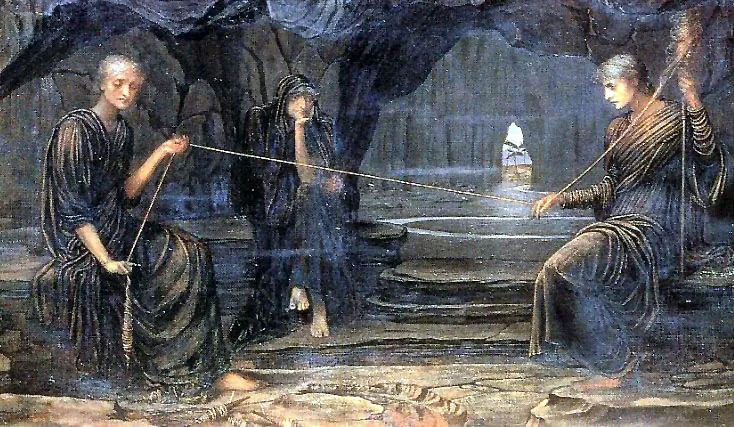
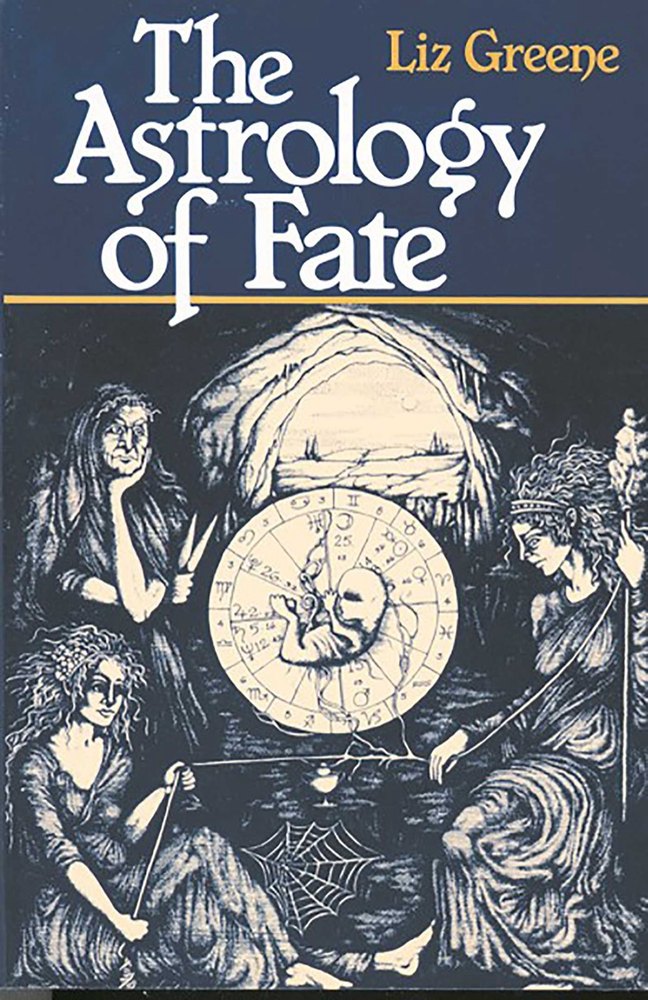
In Greek myth the Moirai are three goddesses: one spins the thread, one measures it, one cuts it. Greene relates them to three phases of the Moon. Why is this power always imagined as feminine? Her answer is that we experience it in the body. The shape of our face, our build, the constitution our parents passed on are things we cannot change, and everyone's first world is the mother's body. She illustrates this with the fairy tale Briar-Rose. The king has only twelve golden plates, and there are thirteen wise women in the kingdom, so one must be left out. The slighted one arrives and declares that at fifteen the princess will prick herself on a spindle. Greene notes that a year has twelve solar months and thirteen lunar months: the king sets the measure of the Sun above that of the Moon, and his own problem with the feminine falls upon his daughter. In the fairy tale no one ever says the curse is unjust, because it is a law of nature.
Chapter 2: Fate and Pluto
The name Pluto originally means wealth; the ancients used it to avoid naming directly the dreadful Hades, lord of the underworld. Greene explains Pluto through the Sumerian myth of Inanna's descent to the underworld. At each gate Inanna is stripped of a garment or ornament, and after passing the seven gates she is naked and bowed low. Greene says she has seen this process in many people's Pluto transits and progressions: the things they once used to define themselves are lost one by one.
A businessman who published science textbooks came for a reading while transiting Pluto was making a long conjunction to his natal Sun in Libra in the tenth house. He had decided to sell his company and go to Australia to run a large farm. He had expected to feel excited, but instead was low and anxious. He dreamed that he had died, that the books he had published stood in a glass case like trophies, and that his mother was weeping bitterly before the coffin. The dream gave him a little hope in the trough, and later he understood that the decision meant the end of his mother's dominion over his life.
Chapter 3: The Astrological Pluto
When Pluto falls in a person's chart, one looks at its house and at the personal planets it aspects. The house, in her view, is like the scenery of a play, a landscape painted in the psyche and then projected onto the people and events outside; so wherever Pluto falls, that area of life becomes the place where this person meets what is not his to choose. She declines to go house by house and aspect by aspect, saying she does not want to write a cookbook. On Mars and Pluto, she writes of people who run again and again into the wall of the other's refusal, and the harder they push, the greater the outer resistance. At such times she thinks it more fitting to accept the part that cannot be changed, go down into the underworld, and see what the goddess there wants.
The chapter also discusses what Pluto gives. In the people she has seen, it is a capacity to survive and a resilient inner core, not necessarily gentle or selfless, but unafraid of separation and pain. The chapter ends with the fairy tale Mother Holle. The diligent girl jumps down the well, takes the bread out of the oven when it asks, shakes the apples down from the tree, and comes home covered in a shower of gold; the lazy one comes home covered in pitch that she can never wash off.
Chapter 4: Fate and the Family
Greek tragedy knows a kind of family curse passed down from generation to generation. Beginning with Tantalos, generation after generation of this family wound one another, until Orestes, ordered by Apollo to avenge his father, offends the Erinyes and is pursued by them. In the end the Athenian court votes and the votes are equal; Athene casts the deciding vote and at the same time gives the Erinyes an altar, and from then on they are called the Eumenides, “the kindly ladies”. Only then is the family curse laid to rest.
From here Greene turns to astrology. Many psychotherapies look at the family in terms of cause and effect: the child grows into whatever the parents' treatment makes him. Astrology offers another view: the image of the parents, their unresolved problems and the nature of their marriage are already written as images in the chart at the child's birth:
The horoscope tells us, in other words, that what is in the parents is also in us.
That is why the same sign or the same set of aspects turns up again and again in the charts of one family, with no causal explanation to be found. She also cautions that the planets in the chart are not the parents themselves; no mother is simply Pluto. The fourth and tenth houses depict the two parents within the child's psyche, with a mythic flavour, and a person has to deal with them all his life; if he forcibly cuts himself off from the family, they turn in a worse direction.
Chapter 5: Fate and Transformation
This chapter covers the methods by which the ancients tried to change their allotted portion. The Platonists divided the person into spirit above and body below, enduring the lower by identifying with the higher, while alchemy sought to transform matter itself. Greene says she makes no judgment on whether these views are true. Her own conclusion comes later in the chapter: the birth chart does not change, nor does the rhythm of transits and progressions; what can change is the clothing it wears, that is, the level at which it takes place. Inner work does not alter a person's innate pattern; rather, it makes the pattern clearer.
Chapter 6: The Creation of the World
The last chapter of the first part is only a few pages long, a retelling of a creation myth with no commentary. Zeus and the goddess Rhea agree on how to divide the world, and Rhea laughs, because she has not given up the three most important things: the winds, death and human destiny, which Zeus was never afterwards able to take from her.
Chapter 7: Fate and Myth
The second part begins with the story of Oedipus. Greene points out that the Greek word mythos means both a story and a plan or scheme. The motifs that recur in myth show that a human life carries an inner plan, which Jung called the archetype. The birth chart is the same, both a story and a plan: myth depicts the pattern shared by humanity, and the chart depicts the individual's portion of it.
She divides the part of life that is not ours to choose into two kinds. Moira is the allotted portion, leaning toward the body, heredity and death. The daimon, originally “the one who allots”, is the force that pushes a person from within to grow into his own unique shape; in a passage she quotes, Heraclitus says that a man's character is his daimon. She suggests reading myths as one reads poetry, by feeling and imagination, rather than checking whether every Sagittarian you know has a wound on the thigh.
Chapter 8: Myth and the Zodiac
This is the longest chapter in the book, and Greene often pushes the familiar image of a sign one step deeper. Taurus carries the shadow of Hephaistos, the smith god, who was born so weak that his mother Hera, ashamed of him, threw him down from Olympus. Greene has seen this pattern in many Taurean childhoods: the family hoped for a dazzling child and got a slow, steady one instead. The famous indecision of Libra, she believes, comes from fear of consequences, not from any innate lack of the capacity to choose. Whichever goddess Paris gives the golden apple to, the other two will be enraged; yet if he does not choose, Zeus will not let him off.
The myth of Sagittarius is the centaur Cheiron, accidentally wounded by a poisoned arrow; the wound will not heal, and since he is immortal, he cannot die either. Greene says that beneath Sagittarius's bright optimism there is often a layer of disappointment and hurt, and perhaps it is precisely because of this wound that Sagittarius is able to give hope. The Capricorn section contains the prison dream mentioned earlier. At the end of the chapter she explains that, for readability, she has written each sign as though discussing only the Sun sign, but the Ascendant, aspects and houses can all be read in the same way. Several themes often recur in a single chart; they are the chart's backbone, and the main thread of the person's life.
Chapter 9: Fate and Synchronicity
The third part deals with Jung's synchronicity: an inner state and an outer event occurring together and corresponding meaningfully. Greene tells the story of the Jungian analyst Gerhard Adler. In Berlin around 1928, after two nights in a row of dancing, he was too tired to go out, but a friend persuaded him to go to a party, where the friend introduced him to a woman with the words “Dr Adler, Mrs Adler.” The two shared a surname and became good friends; this Mrs Adler knew Jung's work and roused his curiosity about Jung, and he later became a Jungian analyst.
The Boston episode described earlier is also told in this chapter. She also writes of something common in her practice: for a period, the clients who came to her would one after another have the Sun, Moon or Ascendant in the same sign, and at those times she herself was often going through something connected with that sign.
Chapter 10: Fate and the Self
The last chapter gathers together what came before. When life deals a person a sudden heavy blow, Greene says, we are meeting the face of Moira; when life seems to be leading a person toward a goal, we are meeting the face of Pronoia, and the two often appear at once. What Jung called the Self holds these two faces together; it is the whole chart, and a little more than the chart. She has seen some people who are nothing like their charts, like cardboard figures cut out of a magazine, and the chart cannot explain why. She has also seen many people who, as they came to know themselves better, grew more and more like their charts, especially more and more like their Sun signs:
Far from 'transcending' the birth chart, the individual seems to become more at home in it
With the same transit of Saturn over natal Venus, one person starts a family and another separates. Greene says the inner meaning of the two events is the same, both a matter of facing the other person as they really are, only each tailored to the individual. At the very end of the book she admits that, as at the beginning, she still has no answer, and then tells the fairy tale The Fisherman and His Wife: the wife goes from asking for a little cottage all the way to asking to be like God, and the flounder finally says, go home, she is back in her pigsty. What the story is about, Greene leaves the reader to decide.
How to Read This Book
Chapter 8 has a section for each of the twelve signs, and this is where readers most easily recognize themselves. You can turn first to the sections on your Sun sign and your rising sign, then go back to the introduction and Chapters 2 to 4, where the first part's discussion of Pluto and the family mostly lies.
This is not an easy book. It is written mainly for astrologers and analysts and is packed with Greek myth and Jungian concepts; fortunately there is a glossary of mythological names at the back to consult whenever you get stuck. Most of the case histories are heavy, and Greene does not skirt death, anger or loss. It was written in 1984, and Greene says that she has personally seen only people with Pluto from Gemini to Libra; the only generations the book discusses in detail are those with Pluto in Cancer and in Leo, so people born after Pluto left Leo will find no description of their own generation. And since she refuses to write a look-up manual, readers wanting to find out “what Pluto in such-and-such a house means” will find that she gives directions, not entries.
She makes the method clear and leaves the specific chart for readers to work out themselves. What Your Fate in Depth works out for you are the points where the book most often lands in a chart. The house your Pluto is in is the area of life where you are most likely to meet what is not yours to choose, and if it aspects your personal planets or Ascendant, the report discusses these one set at a time. The Midheaven and IC are read as the two inner parents you carry out of your family, not written according to your actual parents. Your Sun sign and rising sign are read through myth, as in Chapter 8. Which points in your chart Pluto, Uranus and Neptune will touch over the next five years is calculated precisely by software. The other planets and houses in your chart are not taken up one by one.
The report's final section borrows a saying of Jung's that Greene also quotes several times in the book: free will is the ability to do gladly what one must do.
 Your Fate in DepthSee report · $19