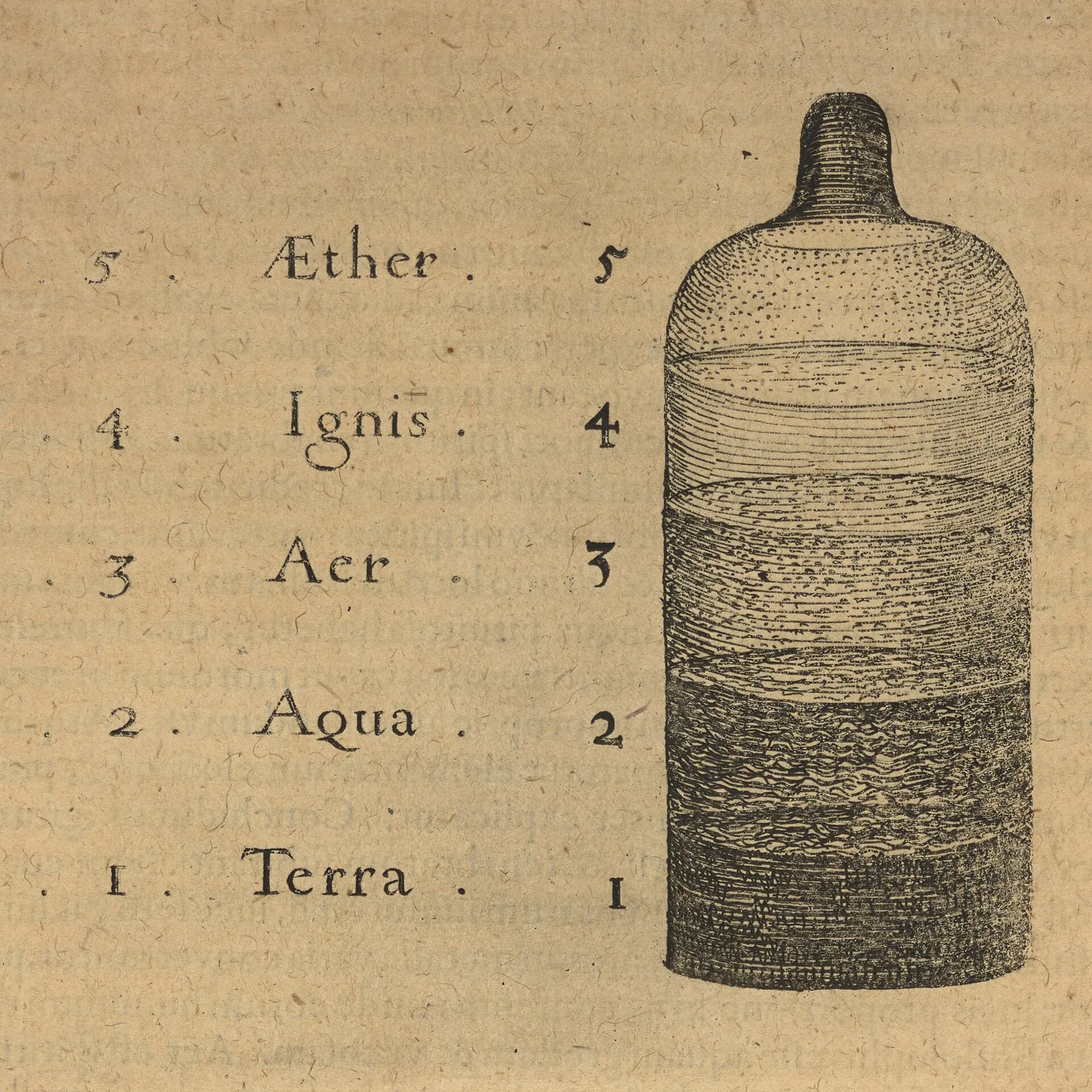
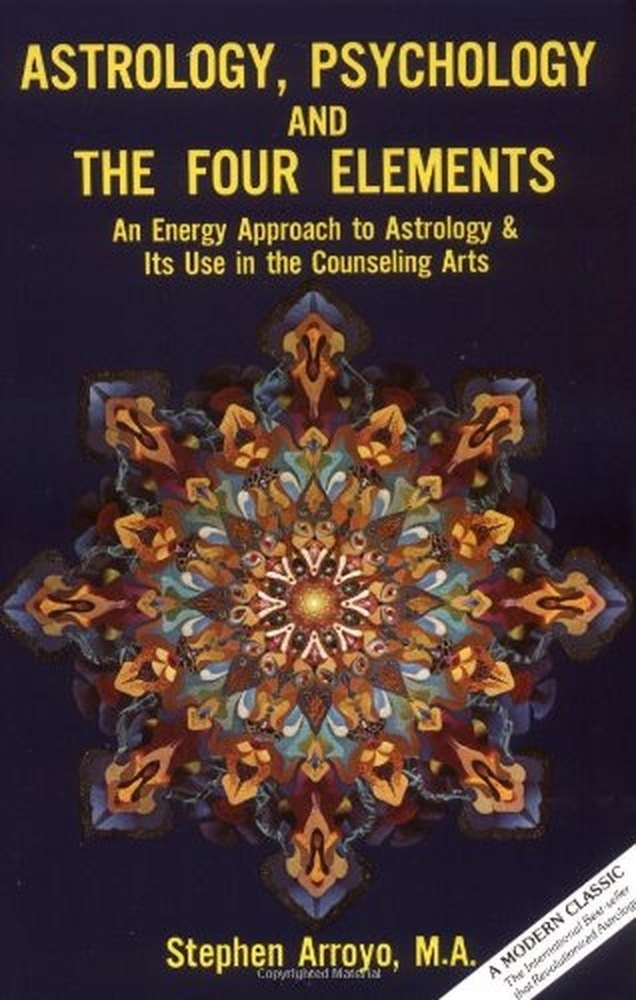
Astrology, Psychology & the Four ElementsAn Energy Approach to Astrology & Its Use in the Counseling Arts
Stephen Arroyo
Which element supplies the energy that makes you feel alive.
Which Element Restores You
After a tiring stretch, people want very different things. Some want to spend an afternoon by the sea, some want a friend they can really talk to from early evening deep into the night, some cannot recover without working up a sweat, and some only want to go out into the garden, turn the soil and plant something. In Astrology, Psychology & the Four Elements, published in 1975, Stephen Arroyo places this difference in the four elements of fire, earth, air and water. Everyone has all four, but which ones each person is most closely attuned to differs, and which one restores your strength when you are worn out can be seen in the birth chart.
The book has two parts of eight chapters each. Part I is on astrology and psychology; its first six chapters were originally the thesis Arroyo wrote for a master's degree in psychology at California State University, Sacramento, and in 1973 the thesis received the Astrology Prize of the British Astrological Association. Part II is the backbone of the book. Here Arroyo uses the four elements to give all of astrological theory a foundation in terms of energy, hoping to help people see a simple order among the countless combinations of a chart: which element gives you strength, which you do not normally connect with and need to cultivate deliberately, and, when two incompatible elements live in one person, where that person will be at odds with himself.
In the chapter on individual psychology, Arroyo looks first only at the element of the Sun sign, because it is usually a person's most dominant element, showing what kind of experience his consciousness is rooted in, and what counts as real for him. He goes on to write:
the element of one's Sun sign is the fuel that you need to feel alive!
Fuel gets used up, so it has to be replenished. Arroyo gives the example of an air person whose nature calls for using his mind and communicating with others, but who earns his living by physical labor. If this person does not seek out people to talk to or do something mentally engaging after work, he will gradually run down, because his air is never replenished. So for a job to remain satisfying over many years, it is best that it suit one's element.
The way to replenish differs by element. Water people need to throw themselves into something emotionally intense; fire people need an inspiring goal or work that calls for physical effort; earth people need to take on practical responsibilities; air people need regular contact with like-minded people. One can also approach the element itself more directly. Arroyo knew a double Taurus woman who had never studied astrology, yet had discovered on her own that what settled her best was spending a few hours playing in the mud by a nearby river. He also had a friend, an Aquarian doctor, who believed that air people do best living at an altitude of at least half a mile, and who lived at such an altitude himself for that reason.
The Neglected Elements
At the start of Chapter 10, Arroyo criticizes a trend: many astrological writers, wanting to make astrology look more like physical science, had all but set the four elements aside, and some even said that chemistry now had a periodic table and there were far more than four elements. Teachers who still used the elements seldom explained clearly what they are or how they work. Arroyo holds that the elements are the foundation of the zodiac, and therefore of all astrology. On this he agrees entirely with C.E.O. Carter: the four elements are not merely symbols or abstract concepts but refer to the life forces that make up everything perceptible.
Those who use the elements to read a chart commonly just count how many planets fall in each element, one planet to a share. Arroyo says many astrologers count this casually, and their judgments are often wrong as a result, after which they go looking for all kinds of esoteric reasons to explain the error. He argues for weighting: the Sun counts most, then the Moon, the Ascendant and Mars, then Venus and Mercury, and finally Jupiter and Saturn. The elements of Uranus, Neptune and Pluto describe a whole generation and are left out of the individual balance. The elements of the Ascendant ruler and the Sun ruler are given extra weight.
He gives the example of a woman with six planets in Aries: the Sun, Moon, Mercury, Venus, Jupiter and Uranus. By the counting method she should be a typical fire person, easily written off as concerned only with herself. But Mars, the ruler of Aries, is in Pisces, the only planet in water in her chart, so her Aries drive carries a sensitivity rarely found in an ordinary Aries.
His other change goes deeper. In traditional practice, astrologers were mostly telling fortunes, assuming that a chart records what events a person will meet in the outside world, that these events can be predicted, and that most of them cannot be changed. Arroyo thinks the other way round. The more complex a thing is, the harder it is to predict, and human beings, with reason and will and the ability to step back from their own situation, are the hardest of all. The more conscious a person is, the less he needs to run into a concrete event in order to learn the same lesson. From this he concludes that the degree to which a person can be predicted is in direct proportion to his lack of awareness.
These ideas have their source. Arroyo dedicates the book to Dane Rudhyar, and says in his preface that this new astrology began with Rudhyar's The Astrology of Personality in 1936; it has moved slowly because astrologers often need many years to let go of the old framework they first learned. The other figure the book cites often is Jung, and Arroyo says the energy patterns the signs represent are the same thing as what Jung called archetypes.
The Girl Taken for a Problem Child
When a child's energies are incompatible with both parents', the child often seems tense and sensitive, and the parents cannot understand him; Arroyo saw this many times in his practice. One such girl had the Sun in Leo and the Moon in Aries, heavy in fire, while her parents had their Suns in Cancer and Taurus. As a teenager she was treated by her parents as a problem child, someone with so much fire who was nonetheless unusually tense and very insecure. She left home as soon as she finished high school, and within two years she had the poise and confidence such a chart should have. Arroyo's conclusion:
she was not the problem; the relationship between her and the parents was the problem.
When a child never seems right at home, adults usually ask first what is wrong with the child; Arroyo looks at whether the elements of the people involved are compatible. A fire child living with water and earth parents has to deal every day with energies that do not suit her. Once she left home and no longer faced them daily, who she really was could come out.
He takes the same approach to placements in general and does not readily call any of them bad. Some writers say people with Saturn in a water sign are cold and unfeeling; Arroyo says the reality is just the opposite. Such people are too sensitive emotionally and guard their feelings too hard against being hurt by the world, so they dare not express their emotions openly. They look cold, but inside they feel a great deal. The direction he gives is to practice, with restraint and self-acceptance, putting feelings into words. As the person gradually relaxes, the energy that fear had been holding down becomes available for him to use himself.
Knowing Where You Come From
If you find that you do a job reasonably well yet grow more and more drained the longer you do it, Arroyo's view is that you should first ask whether the job suits your element. What the book most directly offers is this way of looking at yourself: the elements strong in your chart are the ones you connect with naturally and use without effort, and those you lack are the part you do not normally connect with and need to cultivate deliberately. Arroyo is clear that analysis and talk alone cannot change which elements a person is innately attuned to, but a person can gradually recognize which people and which activities can teach him just what he needs.
People with very little earth, for instance, often feel they have no place to stand in this world, and do not easily find satisfying work. Having little earth has its advantages too: such people set themselves no limits, and their imagination can range freely. But Arroyo says this imagination will bear fruit only after the most basic demands of practical life are accepted. Only by first accepting the limits of the material world can one draw on earth's enduring strength.
Another place it helps is in relationships. Two people like each other and stay together for many years, yet one of them gradually finds that however hard they try, they can never be fully themselves with the other, never share the innermost part. Arroyo has looked at the synastry of many couples and lovers, and says this is the most common reason relationships slowly fade: when a person is not closely attuned to a certain element, it is hard for him to enter fully into that kind of experience. He also cautions that synastry data cannot be used to decide whether a relationship will be painful or happy; the two people's level of awareness always matters most.
Chapter by Chapter
The eight chapters of Part I can be read a few at a time together; every chapter in Part II bears directly on chart interpretation.
Chapters 1 to 3: Modern Science & Psychology Today; The Limitations of the Old Framework; Different Approaches to Knowledge & the Question of Proof
These three chapters are written mainly for people who do not know astrology or even doubt it, and they answer the question everyone asks: can astrology be proved? Arroyo distinguishes two kinds of proof. Statistical proof is useful for a group of people but says almost nothing when applied to a particular individual. The other is what Rudhyar called existential proof: a person studies his chart and for the first time finds that experiences that had seemed chaotic and purposeless now hang together and make sense, and feels that his life has a direction; for that person, astrology has proved itself. So Arroyo holds that the real question is whether astrology is of value to people; the rest of the debate over proof is, in his view, merely academic.
Chapters 4 to 6: Archetypes & Universal Principles; Approaches to Astrology; Humanistic Psychology & Humanistic Astrology
Chapter 4 uses Jung's archetypes to discuss the signs and planets, and Chapter 5 compares several approaches to explaining why astrology works; the three chapters arrive at humanistic astrology in Chapter 6. This school, represented by Rudhyar, shifts the emphasis from external events to a person's inner experience and growth. In looking at a person's difficulties, the question changes from “what kind of problem a person has” to “what kind of person has a problem.” Transits and progressions are still examined, but their meaning changes: what was once seen as a senseless ordeal is now seen as an opportunity for a person to experience and integrate a new side of himself, and painful experiences take on a meaning for growth.
Chapters 7 and 8: The Uses of Astrology in the Counseling Arts; Notes on Education & the Training of Astrological Counselors
Chapter 7 is about what astrology can do in counseling, and Arroyo lists sixteen points, such as helping people gain a little distance from their own minds and habits, and knowing that every phase will end with its cycle, and so having a little more patience. He is very demanding of astrologers themselves: if you don't know, say you don't know. Because in the client's eyes the astrologer's words carry the authority of the whole universe, he says it is better to say nothing than to guess casually from an inadequate understanding.
Chapter 8 is about education. He uses the four mutable signs to lay out four stages of learning: Gemini learns the basic skills; Virgo serves an apprenticeship, honed in practical work; Sagittarius begins to master the craft and influence others; Pisces turns inward. He found that many astrologers start teaching and writing as soon as they have learned the basics, skipping the long Virgo stage of practice, so what they say is often just a retelling of other people's words, never tested in practice.
Chapter 9: Astrology: A Language of Energy
This chapter sets out the vocabulary the whole book uses. Planets are dimensions of experience, signs are qualities of experience, houses are the fields in which these energies operate, and aspects show how all of these are integrated in a person. So the side of life a planet represents is colored by its sign, met most directly in its house, and expressed smoothly or not according to its aspects. Arroyo also explains why the chart is cast for the moment of the first breath: only from that moment does the newborn begin exchanging energy directly with the universe. What is set then is a person's original keynote, and the task from then on is to tune oneself along that keynote so that it is expressed as well as possible.
Chapter 10: The Four Elements: The Basic Energies of Astrology
This chapter takes the elements one at a time. Traditionally fire and air are counted active and outwardly expressive, water and earth passive and inwardly contained. Arroyo takes care to explain that calling water and earth “self-repressive” describes how this energy operates and does not mean that people strong in water and earth are less aware. Water and earth people live more inwardly and think carefully before putting their energy out; fire sends its energy out through direct action, and air through dealing with people and through talk.
In discussing earth, he describes how earth people see the other three elements. To earth, air people are like children in the clouds playing with impractical schemes, and fire people rush in too fast and too hard, parching the earth, and cannot be relied on, while water people are like rain, making the land bring forth more.
Chapter 11: Psychology of the Individual
The element of the Sun shows “where you're coming from.” Drawing on the research of the psychologist Ralph Metzner, this chapter describes how each of the four types deals with conflict. Air people handle it gracefully at the time, floating above the conflict, and may only afterward resent the person who gave them trouble. Water people dislike conflict and go around it; only Scorpio often goes looking for a challenge. Earth people would rather absorb a problem slowly, but backed into a corner they hit back with full force, Taurus above all. Fire people seldom bother with tactics and roll over obstacles by sheer force.
Chapter 12: Elements in Interpretation
This chapter goes through too little and too much of each of the four elements in turn, then combinations in which two elements are both emphasized. Arroyo's starting point is that everyone has all four elements, since no one could exist without any one of them; to lack an element means not normally being in touch with it. Too much has its difficulties as well. People heavy in earth are strong and efficient, but work and practical matters easily fill their whole lives, and when an unexpected change comes in their career, their whole sense of their own worth is threatened. On combinations, he cites Zipporah Dobyns in calling people strong in both fire and earth “steam-rollers”: fire gives initiative and creativity, earth gives practicality, and when everyone else has fallen, they are still moving forward. Their fault is that they seldom reflect on themselves, and do not care whom they flatten along the way.
Chapter 13: Potential for Integration: Aspects & Planetary Relationships
Arroyo holds that the elements are the primary basis for interpreting aspects, and that in reading any chart you can begin by asking whether the elements of the Sun and Moon are compatible. He gives the example of a man with the Sun in Virgo and the Moon in Leo; the two planets form no aspect, but their elements do not get along. Virgo is what he is in essence, and he shines most when he is modestly doing practical things for others. The Leo Moon, though, makes him want unconsciously to impress people and to stand at the front. Virgo's modesty and Leo's pride will not come together, and this became a very hard threshold for him to cross in integrating himself. As for what to do with such a conflict, Arroyo answers in Jung's words:
a true conflict is never resolvable on the same level of consciousness where it is experienced. It can only be outgrown.
Only when a person's awareness has grown to the point where he can see both sides of the conflict at once, and accept both, does the feeling of conflict begin to dissolve. The two planets get in each other's way, yet he must satisfy both needs before he will feel he is living a whole life.
Chapter 14: Planets in the Elements
Every planet has two sides: outwardly, expression; inwardly, need. Take Venus: its element shows how you express love, and also what kinds of experience make you feel loved. People with Venus in a water sign need a continuous emotional response; this kind of exchange needs few words and no grand gestures, so people not on the same wavelength often fail to notice it. Arroyo also tells of something that happened in class. A woman sitting at the back, twenty rows from the lectern, asked a question, and before she had finished he had understood her completely. When he asked, her Mercury turned out to be in the same sign as his, at almost the same degree.
Chapter 15: The Elements in Chart Comparison
In the chapter on synastry, Arroyo opposes a popular idea: that whatever element you lack, you should find someone who has it to make up the difference, so that between the two of you all four elements are complete. He says this sounds fine on paper but often does not work in practice; when two people are too different, the distance between them in consciousness and experience grows year by year, and such a relationship is better regarded as a short-term arrangement for growth. He also imagines a Cancer and a Gemini living together: Cancer may feel dried out, Gemini may feel smothered under water and unable to get out of bed in the morning, and once they live apart, both may be surprised at their relief.
Chapter 16: The Elements & the Houses: A Key-word System
Arroyo taught many astrology classes and found that students learned the signs and planets quickly but became confused as soon as the houses came up. He believes the trouble is that most books merely list the traditional meanings of the houses and rarely explain the fundamental principle of each, and they are mostly concerned with external circumstances, while few speak of a person's inner experience. His view:
The truth is that the chart inevitably shows "what one is going to experience."
He takes Saturn in the fifth house as an example. To say this person “has trouble with children” means nothing; who doesn't have trouble with children? To say his creativity is limited is also wrong, since a number of great artists and writers have this placement. Define the core of the fifth house as the field where one “seeks security for one's own identity”, and whether this shows up in children, lovers, creative work or something else, it speaks to what the person actually experiences.
How to Read This Book
The first six chapters of Part I were originally a master's thesis in psychology and cite a great many names; readers who want to use the elements to look at their own charts will find it more direct to start at Chapter 9. Chapters 9 and 10 make energy and the elements clear, and Chapters 11 to 14 are the core of chart interpretation, best read straight through with your own chart at hand, noting which element your Sun, Moon, Ascendant and Ascendant ruler each fall in. Chapter 15 is on synastry and Chapter 16 on the houses. Arroyo himself says beginners may not have an immediate use for this set of house keywords; keep them in mind and compare them later, when you learn the traditional meanings of the houses. Part I deals with the 1970s debates between astrology, psychology and science, and there is time enough to go back to it once the elements have caught your interest.
Some of the book's limits Arroyo states himself. Part II deals with basic principles and has to generalize in many places, so he warns readers not to identify only with the element of their Sun sign, nor with any single factor in the chart. The research listed in the appendix consists entirely of reports from before the book was published, and he says none of it amounts to decisive proof that astrology works; read today, it is best taken as material from that era. The elements, too, are only one layer of the chart; as he says in the synastry chapter, the specific aspects between two charts still have to be examined one by one.
Your Four Elements in Depth reads your own chart by Arroyo's method. The balance is counted with his weightings: the Sun counts most, and the rulers of the Ascendant and the Sun are given extra weight, so which elements come out strong and which lacking often differs from a simple count of planets, just as with the woman with six planets in Aries, whose sensitivity was hidden in her single water planet, Mars. Which elements your Sun, Moon and Ascendant fall in, and which pairs of planets sit in incompatible elements, are also brought out, with an explanation of what each side needs; the Sun-in-Virgo, Moon-in-Leo man of Chapter 13 is just such a pair. If any element is weak or missing in your chart, the report discusses separately which people and activities you can turn to in daily life to replenish it. Everyone has all four elements; this report reads only the layer of the elements: which one gives you strength, and which one you need to replenish deliberately.
 Your Four Elements in DepthSee report · $15