The Astrological Neptune and the Quest for Redemption
Liz Greene
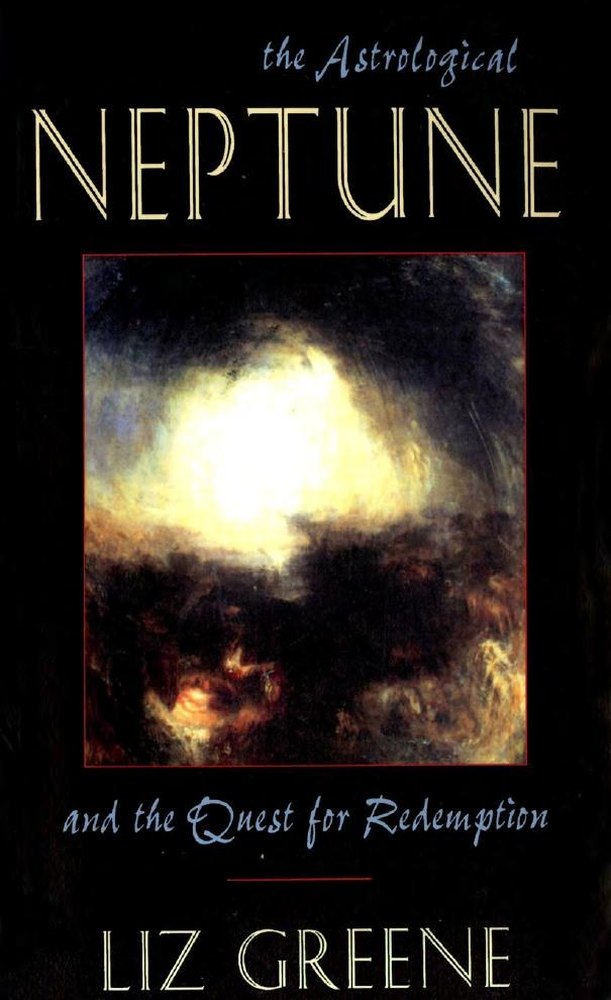
The longing to return to a place without boundaries falls in the house where Neptune sits.
The “What About Me?” That Goes Unsaid
When you first fall in love with someone, you know what they want without having to ask, and you are willing to become that, little by little. In The Astrological Neptune and the Quest for Redemption, published in 1996, Liz Greene writes about people like this: ten years after the honeymoon, they are still saying “Yes, my darling, I want whatever makes you happy”, while inside they are thinking “No, damn it, what about me?” Why can this never be said? Greene's explanation takes a single sentence:

But the “me” is never spoken, because mirrors are mute.
Greene says that to fall in love and turn yourself into the other person's mirror, reflecting back whatever they want inside, is a Neptunian kind of love. When the mirror has reflected for long enough, the part of you that the Sun, Mars and Saturn stand for has had no outlet, and over the years it builds into deep resentment. This book is about that longing to give oneself away and merge with another. Greene defines it like this: it is a longing, intense and unconditional, that often collides with a person's own values, and its final destination is dissolution, not a relationship. In the language of astrology, this longing is called Neptune.
So people with a strong Neptune often carry a place inside that they want to return to, a place with no boundaries and no separation. The longing can settle on a lover, or on a group or an ideal; it makes people hope that someone will come and rescue them, and it also keeps them busy rescuing others. Greene says the same longing is sometimes a light reaching upward, letting a person feel at certain moments that all things were connected from the start, and sometimes a fantasy clinging desperately to the waters before birth, causing a person to lose themselves again and again. She is in no hurry to call Neptune good or bad. What she asks is when this longing deserves respect, when it is a refusal to grow up that needs to be met with compassion, and when it is both.
The book has four parts. The first three approach the longing through myth, psychoanalysis and collective currents; the fourth is what Greene herself calls the “cookbook”, covering Neptune in each house, in aspect to the other planets, and in synastry and the composite chart. She begins with water, because over many years she kept hearing people who knew nothing about astrology describe themselves in terms of water during important Neptune transits and progressions: drowning, drifting, dissolving, being swept away. Their dreams in those periods were all of water too: tidal waves, sinking ships, leaking pipes, flooded houses. So Greene says that Neptune speaks the vocabulary of water. The comfort of sinking into a hot bath after work and floating without effort is Neptune, and so is the panic of choking on water and sinking further and further down.
Asking One More “Why”
On Neptune, the older astrology books liked the words deception, illusion, addiction and renunciation, and seldom treated it as a purely benefic planet. Another approach went the opposite way: many astrologers were quick to call Neptune “spiritual”. Greene finds both approaches too thin; used to seek answers for clients, patients or oneself, neither yields real understanding. Her example is people with Venus or the Moon in difficult aspect to Neptune, or with Neptune in the seventh house. Such people are indeed prone to being deceived, disappointed and self-effacing in love, but why? If a person will not look at why they keep idealizing their partners, and will not face the hard work of standing on their own inside, no amount of spiritual teaching will protect them, and the same thing will recur again and again in different forms.
Her method is to bring psychoanalysis into astrology. Psychoanalysis has written a great deal about idealization, separation anxiety and the merging of self and object, and Greene says this writing is almost entirely about Neptunian themes. She also says that astrologers mostly approach Neptune by way of Jung and his collective unconscious, but that Freud's early work is just as important, perhaps more so, because it deals with how a person experiences that sea within their own development and ordinary life. Freud called himself an atheist and is often neglected in astrological circles. On where the longing comes from, Freud traced it back to the infant's bliss in the womb and in the mother's arms, while Jung held it to be innate, as old as the urge to reproduce; Greene says both may be right.
The book makes clear which lineages she draws on. On the psychological side, besides Freud and Jung, there is Winnicott, who wrote about mother and infant. On the astrological side, she lists Howard Sasportas's The Gods of Change as one of the most complete works on Neptune, and borrows his definitions when discussing the eleventh and twelfth houses. Sasportas was the colleague with whom she founded the Centre for Psychological Astrology in London. She also often quotes Ebertin's brief judgments on Neptune and then probes a level deeper. Alice Bailey drew up her list of “glamours” in order to root these things out, yet Greene says the list describes exactly how Neptune works in each of us.
At the end of the book she says that astrologers who see Neptune as something bound to come to pass may find the book offensive. But many astrologers and clients are not content to be told they must suffer; they want understanding, and a way out of the web that has caught them, and for them a psychological reading is essential. What she means by “psychological” is broad: simply, what belongs to human experience.
No One Can Exchange Their Neptune
People with a difficult Neptune often blame their chart first, or the home they grew up in. Greene accepts neither entirely. She grants that difficult Neptune aspects often seem to describe the childhood environment, especially when they involve the Moon and the tenth house, the places that stand for the mother. But what the birth chart ultimately tells us is how we respond to the world and what we see in it. A chart cannot say whether a person will manage to live outside Eden, only which direction they will travel, with which conflicts and which resources. So she says:
One cannot send in and get a new, nicely aspected or less prominent Neptune.
She adds at once that one should not wish to. What can be worked on is the care in childhood that was not good enough. If you were the child in your family who was always first to notice that your mother was unhappy, the following will probably feel familiar. Greene writes that the Neptunian child is especially sensitive to the suffering of others. To a child at the start of life, the mother is the whole world, and when the mother is unhappy, the world is full of pain. So the child learns very early to set aside its own needs and take on the task of making the mother well. As adults, such people often enter the helping professions, become overwhelmed by their work, and always ask for too little time and money for themselves. Greene does not blame the mother either; she says the most that can be said of such a mother is that she, too, is still a child inside.
Beyond understanding, she also refuses to let people use the planets as an excuse. She says she has heard too many people say they cannot manage money “because” Neptune is in their second house. Her advice is to take the words “I can't help it” out of one's mouth and replace them with the more honest “I won't help it” or “I am afraid to help it”. For the person who says “I can't help it”, it is usually parents and partners who end up paying the bills; only by putting it differently can one see that part of the problem is not really wanting to be independent. She also says that the most precious resource of those with Neptune in the second house is an intuition of the oneness of life.
Telling Apart Yourself, the Other and the Source
Feeling that you have never given so much, and yet have received nothing in return: Greene says Neptune transits often fall at times like these. She borrows Jung's words: giving something while hoping for a return is only an exchange, not a sacrifice. What is exposed at such a time is the bargain that has been quietly running inside, the hope that someone will rescue you because of it. What has to be let go is that bargain; neither happiness nor the things that make you happy need be given up.
What is left after Neptune's deluge is oneself.
Greene says this self is naked and vulnerable, yet, having seen through its own calculations, it is wiser and stronger for it.
Neptune can be recognized in love as well. Idealizing the other person, Greene says, is not a flaw, merely unrealistic, because no one can give another person a god's salvation. When disappointment comes, it is easy to blame the other for being heartless; what she urges is learning to tell apart yourself, the person you love, and the sacred source within. On the seventh house she says that perhaps the secret lies in allowing others to be at once figures of myth and ordinary mortals.
It is useful in caregiving too. People with Moon–Neptune aspects often treat themselves as food, feeding every mouth that comes asking, and being needed becomes almost the theme of a lifetime. Greene's words to them are very plain: learn to say “No”. She says people with Moon–Neptune aspects must first be a good Moon, acknowledging that their own bodily and emotional well-being comes first, and only then go on to meet the needs of others.
Chapter by Chapter
Chapter 1: Creation
Neptune's myths begin with water. Greene sets two kinds of creation myth side by side. In Babylon, Ti'amat gives birth to the gods, then seeks to destroy them, and is finally slain by her son Marduk, who makes heaven and earth from her body. In Indian myth, the whole material world is a dream of the mother goddess, and all meaning rests with her. Greene says these are two ways of feeling the same experience. A person with a strong sense of self will treat the waters of the source as a devourer that must be defeated; a Sun or Mars square Neptune, especially in fire or earth signs, may feel it this way. A person whose sense of self is still fragile will treat it as the only bliss; the chart might show an angular Neptune trine the Sun or Moon, with water or the twelfth house strongly emphasized. Which one it is, she says, depends on the whole chart, and on family and culture too.
The chapter ends by coming down to the chart: the house where Neptune falls is the area of life onto which we project the source of life.
Chapter 2: The Pursuit of the Millennium
Greene notes that God's punishments for Adam and Eve, the pain of childbirth and the toil of earning a living, are exactly the two most basic tasks of adulthood: becoming a parent oneself and supporting oneself. These are also exactly what Neptune most wants to avoid. She says that to be conscious is to choose, and choosing requires a separate self that makes decisions by its own values. Neptune's bittersweet melancholy is the melancholy of the exile; many people with a strong Neptune have told her that they “didn't want to be here in the first place”.
At the end of the chapter she discusses Noah's ark: built of plain materials like wood and pitch, it floats on the flood, neither drowned by the water nor trying to hold it back. Greene reads it as a container for the self, built through ordinary effort, and the later discussion of how to live with Neptune often comes back to it.
Chapter 3: The Advent of the Redeemer
To want to be redeemed, one needs a redeemer. Greene says the image we hold of the redeemer, pure, generous, never angry, loving without conditions, is exactly the ideal good mother as an infant sees her. Idealization has its own inescapable logic: the idealized person makes us feel unworthy, so sooner or later we come to hate them, or ourselves. Some people instead identify with the redeemer and go looking everywhere for people who need redeeming. On sacrifice, she starts from the etymology: the original meaning of sacrifice is “to make sacred”, and what must be given up is one's identification with the thing, not necessarily the thing itself.
Chapter 4: The Discovery of the Unconscious
This chapter tells the history of hypnosis. The word only appeared in the 1840s, in the same period that Neptune was discovered, and its origins lie with Mesmer, the eighteenth-century Viennese physician. He found that whether a patient could enter a trance and whether they improved depended on a particular emotional identification between himself and the patient, which he called rapport and which psychoanalysis later called transference. From this Greene says that when Neptune transits the Sun or Saturn, it often corresponds to a period in which “psychic” experiences appear in a person's life, because the boundaries of the ego are loosening.
From here she also draws out Neptune's greatest gift: effortlessly becoming what the other secretly longs for, something very valuable in both art and counselling. But if the wounds of childhood have never been looked at, this gift becomes dangerous, because power gained by identifying with an archetype is borrowed.
Chapter 5: The Psychoanalytic Neptune
This chapter begins with Winnicott. He said that the infant at first lives in a “strange place” where “me” and “not me” cannot yet be told apart, and Greene says this is Neptune's world. Only when the mother first gives the child enough Eden is the child willing to leave those waters and live its own life. She goes on to discuss the “pursuit of suffering”. People with a strong Neptune sometimes dare not be happy, because happiness would mean leaving the bond of suffering together with the mother. She separates two things that are often confused: compassion for others, and the kind of suffering that says “I must sacrifice everything and never allow myself to be happy”. She also says that Neptunian self-victimization need not be carried for a lifetime.
Chapter 6: The Liebestod
The Liebestod, the love-death, is borrowed from Wagner's Tristan und Isolde. Greene says that today this longing appears most often in falling in love. She pays particular attention to the “unobtainable”. The other person may be committed elsewhere, may live far away, or may be the very partner beside you, unobtainable forever simply because the love you want is more than any one person can give. She says one must first honestly admit one's own investment in the “unobtainable”; only then does its other side come into view: that impossible love may also be a door into the inner world.
After disillusionment, consolation sometimes lies in creating, because creative work is much like being in love, only with the added labour of bringing the illusion down into reality. Greene says that even if you fear appearing untalented, you should try, even if you only write or paint in private.
Chapter 7: The Esoteric Neptune
This chapter deals with mysticism, psychism and gurus. Greene says at the outset that no planet has a monopoly on spirituality; each planet has its own path to the divine. Mercury meets the sacred in human thought, speech and craft; Saturn in the unchanging laws that hold up the material world; Venus in the harmonies of music and mathematics and in the beauty of nature. So Neptune is no more spiritual than Mercury, Saturn or Mars; it is simply one of the planets, standing for one way of seeing the sacred.
Chapter 8: Neptune and Glamour
Greene says that glamour cannot be manufactured on purpose; the audience will politely watch once and not buy a ticket the next time. Glamorous Neptunian figures are good at sensing an era's unspoken dream and reflecting it back, so, she says, Neptune in the birth chart says nothing about talent; what it describes is the power to awaken other people's dreams.
The chapter also sets Neptune's eighty years through the signs beside fashion and film. When she was writing, Neptune was in Capricorn, and the English were rushing to buy old-fashioned country cottages with thatched roofs and roses climbing round the door. No one thought about the insurance on thatch or the windows that would not shut; what everyone saw was Paradise regained. Her conclusion is that we cannot escape our need for glamour, but we can look with humour at what we are prone to be enchanted by.
Chapter 9: The Political Neptune
This chapter covers how Neptune looks in the collective: how a society gives rise to shared ideals, and how it goes through the disillusionment of those ideals.
Chapter 10: Neptune and the Artist
Many astrologers take a strong Neptune as a reliable sign of creative talent. Greene disagrees: she says creativity is represented in the chart by the Sun and Saturn, because giving fantasy a visible form is a function of the ego. Saturn–Neptune aspects are called the “artist's aspect” because form and boundless imagination can meet in a work; in art, Neptune has to tolerate imperfection, but need not give up the eternal. She takes “art” very broadly, including astrology and depth psychology, and so says that everyone with a Saturn–Neptune aspect needs to be an artist somewhere in their life.
She also counted fifteen English Romantic composers, every one of whom had the Sun or Saturn in aspect to Neptune. With an equally strong Neptune, some composers put it into their music and lived quite steady lives. The key, Greene says, is whether a person is expressing Neptune or being drowned by it.
Chapter 11: Neptune in the Houses
With this chapter the fourth part begins. Greene says the house where Neptune falls is where we search for paradise; there we are both redeemer and the one waiting to be redeemed, and may be victim and victimizer at once. She borrows Manilius's image: a house is an empty temple, which we furnish according to our own nature.
Neptune in the third house speaks vaguely and forgets easily, and is often taken by teachers to be not very bright. Greene says this is an unconscious avoidance of the separation that language brings, and that no planet in the third house, or in any other, can say how intelligent a person is.
Chapter 12: Neptune in Aspect
With aspects, Greene says, the key is not whether they are easy or hard but whether the two planets can become partners within the same self, even if they sometimes quarrel. The Moon will not sacrifice itself; Venus wants to be happy, not to vanish; the Sun is willing to live itself out actively, not to be sacrificed passively. Mars is the hardest to come to terms with, for a simple reason:
Eden is a world without Mars, for anger and oneness are mutually exclusive
So people with Mars–Neptune aspects, when they want something, must first make sure they offend no one, and so they understand the power of the word “we”, which is a great gift in art and in counselling. Greene writes Saturn–Neptune aspects as two voices, one saying “I can't help it, it's everybody else's fault”, the other saying “Stop whining and get on with it”. Both voices are in fact inside oneself; only once this is recognized can the combination turn dreams into reality.
Chapter 13: Neptune in Synastry and the Composite Chart
Greene says that Neptune at work between two people is not necessarily romantic love; it can operate between teacher and student, parent and child, even between an author long dead and a reader a hundred years later. Every such encounter shows us where we have not yet grown:
Any Neptunian interchange with another person will point out to us, often painfully, where we are still unborn.
On Neptune–Saturn aspects between two charts, she says Neptune's favourite accusation against Saturn is “You're trying to control me”; put more honestly, however domineering Saturn may be, what Neptune wanted from the start was a parent to make its decisions for it. On the composite chart, she grants that it often makes a relationship feel inescapable, but she does not believe it determines the relationship's future.
Conclusion
The conclusion returns to astrology itself. Greene says there is no “correct” astrology, and she does not approve of the astrological world drawing lines between the “pure” and the “impure”. Even a washing machine leaking during a Neptune transit, she says, is psychological, because how we deal with it and what we feel about it are part of human experience. She closes by saying that Neptune's greatest challenge lies in whether we are willing to take responsibility for our own part, rather than punishing others.
How to Read This Book
Greene herself says that readers who only want the “cookbook” can turn straight to the last part. Following that advice, first find which house your Neptune is in and which planets it aspects, and read those passages. Once your interest is caught, go back to the part of chapter 3 on sacrifice and to chapters 5 and 6, and you will see where those passages come from. Greene says the myth and psychoanalysis at the front were indispensable to her understanding of Neptune, because the planet is best expressed through images. Her method throughout is to lay out associations rather than hurry to define, so it is worth reading slowly as well.
This is not an easy book. Names from myth, religious history and psychoanalysis come one after another, and some passages need to be read twice. Most of the famous cases in the book are unfamiliar to today's readers, and the generational examples stop in the 1990s. Greene herself cautions that which kind of experience Neptune's placement and aspects lead a person toward cannot be judged from Neptune alone; it depends on the whole chart, and on family background and culture too. So however deeply the book goes into Neptune, it still has to be read together with the whole chart.
Chapter 11 covers Neptune in each house, a few paragraphs per house, written for everyone with Neptune in that house. Applied to one person, you also need to look at which sign it is in and which planets in the chart it aspects. Your Neptune in Depth reads these together on your own chart: it starts from how Greene sees Neptune, then reads the house your Neptune falls in, the sign you share with your whole generation, and its aspects to the other planets in your chart. The chapters on merging, on willing suffering and on love are used to see what this longing might look like in you. When your Neptune meets another person's Sun, Moon, Venus, Mars or Saturn, the report also goes through, one by one, what tends to happen between the two of you. Finally it puts all of this together and discusses how to live with this Neptune. The report reads Neptune alone; when you have finished it, turn back to your house in chapter 11, and it will be easier to see which of those passages written for everyone are about you.
 Your Neptune in DepthSee report · $15