The Combination of Stellar Influences
Reinhold Ebertin
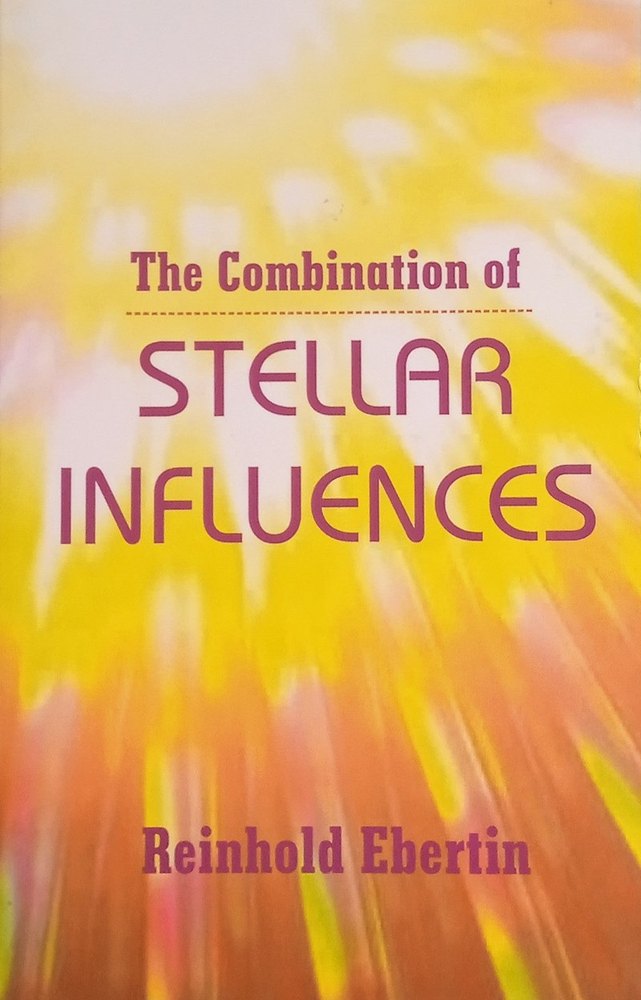
A midpoint reference book that teaches you to read several planets together.
The Third Planet Between Two Others
Most people who have read books on the signs know this moment. The passage on the Sun in Capricorn says you are hard-working, serious and hold fast to your goals; the passage on the Moon in Pisces says you are easily swayed by your surroundings and changeable in mood. Each sounds like you, yet side by side they seem to describe two different people. The German astrologer Reinhold Ebertin wrote The Combination of Stellar Influences to answer exactly this: how the several planets in a chart combine to make one person. Both of the descriptions above can in fact be found in the part of this book on the signs.
The book's German title is Kombination der Gestirneinflüsse. The English translation first appeared in 1960, with a supplement written in 1961 at the back; in the edition we are reading, the introduction is signed Aalen, February 1972. In the introduction Ebertin says he wants readers to see their own dispositions, abilities and possible directions, and to learn to combine the elements of the natal chart into a meaningful self-portrait. It opens with a long introduction on how to read several planets together. Then comes the meaning of the Sun, the Moon, each planet, the Dragon's Head, the Ascendant and the Medium Coeli in the twelve signs; the two passages from the opening are here. The thickest part of the book is the midpoints: the planets are paired off and set out in order, ending with the midpoint of the Ascendant and Midheaven, followed by the supplement. The entries are numbered right through, up to more than eleven hundred.
The idea of a midpoint is not hard to grasp. Two planets lie some distance apart on the ecliptic, and the point exactly between them is their midpoint. When a third planet falls on that point, the three form a group. Ebertin writes it as “Jupiter = Sun/Moon”, meaning that Jupiter falls on the midpoint of the Sun and Moon. He is strict about distance: an aspect is generally allowed 5 degrees, while a midpoint should ideally be within 1½ to 3 degrees, with 3 degrees as the limit.
Take the Sun and Moon as a pair. Ebertin first gives the pair a principle: spirit and soul, conscious and unconscious, vitality and feeling, husband and wife. The good side is a harmonious character and inner balance; the difficult side is inner dissatisfaction, a struggle between duty and one's own inclinations. Only then does the third planet come in. With Venus on the Sun/Moon midpoint, spirit and feeling, masculine and feminine dispositions are in harmony, and he writes of artistic interests and a marriage of love. Put Saturn there instead, and he writes of inner inhibition, loneliness, estrangement from the group, and difficulty with the opposite sex. The same Sun and Moon, with a different planet between them, read as a different person. More than nine hundred midpoint entries are written in this way. He also cautions that these interpretations of combinations should not always be taken literally; they are guides to help one combine.
Witte's Rules, Ebertin's Combinations
Midpoints were not Ebertin's invention, and he explains their history in the introduction. Guido Bonati, the famous astrologer at the court of the Emperor Frederick II, already used the midpoint of two planets when rectifying birth times. Alan Leo wrote of progressed bodies passing over the midpoint of two planets. Alfred Witte, founder of the Hamburg School, learned of the method, according to his student Frank Glahn, from Albert Kniepf of Hamburg, whose writings appeared around 1900. Witte brought it into the practice of modern astrology and called such combinations “planetary pictures”. Ebertin's midpoints come from Witte's research; he used them extensively in his early years and promoted them vigorously, and only later realized that Witte had gone the wrong way in interpretation.
To show where the mistake lay, he sets out a comparison using the pair Saturn and Uranus. For this combination Witte gives only an event, sudden separation; for the principle and the psychological correspondence, his table has question marks. Ebertin reasons from the planets' own meanings. Saturn is inhibition, Uranus sudden excitement, and together they are emotional tension. A person under emotional tension is easily irritable and restless, and wants to rebel and break free of restraint, so the possible manifestations are causing unrest around one, separation, or the use of force. Separation is still there, but now as the last step in a chain of reasoning whose every earlier step the reader can see. He says the two readings differ fundamentally in definition, in practical evaluation and in method of interpretation.
Witte's problems did not end there. He posited four planets beyond Neptune and set up new rulerships and a new house system; a comment Ebertin quotes says this added 2,280 new claims without evidence. Ebertin's own changes lie in how the chart is read. He stopped using “favorable” and “unfavorable” and used “+” and “-” instead, because experience showed that calling every square and opposition unfavorable, and every trine and sextile favorable, is not always right. In his view, trines and sextiles indicate a state, while squares and oppositions indicate an action or an event. He also set the houses aside, because there are too many house systems, most of them carrying questionable claims, and daily practice showed that very good results can be read without the traditional houses.
The traditional interpretations of the houses can lead to results which, from a psychological and moral standpoint, are irresponsible.
His example is that if one insists on reading the second house as money and the seventh as marriage, there is no way to evaluate a chart on a scientific basis. His school is called cosmobiology; the name was coined by others, and became better known through nearly forty years of his work. As the introduction defines it, cosmobiology studies the possible correlations between the cosmos and organic life, using modern methods such as statistics, analysis and computers, without neglecting the unmeasurable connections between macrocosm and microcosm. What Ebertin wanted was to bring together the tradition of ancient astrology and modern psychology, and to explain what a person encounters from his physical and psychological endowment.
The Moon and Saturn Make an Aspect Every Three or Four Days
When transiting Saturn passes over the natal Moon, traditional rules predict several specific misfortunes, one of them being that domestic life becomes difficult. Ebertin gives this example in the introduction, and he does not follow it in predicting events. Whichever event is predicted, he says, what can really be seen is the emotions represented by the Moon meeting the repression represented by Saturn: the person is low and unhappy. Such a mood can be judged with some confidence; the specific event cannot, because there are always influences at work that we cannot determine.
On the pair Moon and Saturn he adds a footnote. People tend to see any aspect between the Moon and Saturn as tragic, yet on average the Moon forms a new aspect with Saturn every three or four days. A negative interpretation is usually right only in a few cases: where environmental influences are strong, the relationship with the mother has been unsatisfying, the family has been separated, or relationships between people never last. So before passing a negative judgment, he wants first to see what kind of environment the person grew up in.
The entries end after the midpoint of the Ascendant and Midheaven, followed by a general statement for those who counsel others. Anyone engaged in this study, he says, must consider with every word spoken what harm it could do if it were wrong.
One does not help others by making them afraid of the future
He goes on to say that one should use every opportunity to help the other person build self-confidence and recognize his own worth. Nor is it the counsellor's place to make decisions for others; what the counsellor should do is help them make decisions as best they can.
From One Planet to a Group of Planets
The most direct use of this book is that it adds a question when you read your own chart: what falls on the midpoint of these two planets? The two seemingly conflicting descriptions at the start need not be a choice of one or the other here; what matters is which planet falls on the Sun/Moon midpoint, and on which other midpoints the Sun and Moon themselves fall. The state of a planet, Ebertin says, is to be determined by taking its aspects together with the midpoint combinations it occupies.
Next is a sense of proportion. An aspect between slow planets such as Saturn and Uranus can be present in the charts of everyone born over an entire year. Ebertin says a combination of slow planets can be called a person's own characteristic only when it is brought out by personal points such as the Sun, Moon, Midheaven or Ascendant; something like “a powerful person” can be said only in certain cases. So when you read that people born in a certain year are like this by nature, first check whether that combination touches your personal points. Only if it does is it about you.
There is also a way of looking at difficult aspects. Saturn on the Sun/Mercury midpoint is common among philosophers who must think deeply and seriously about hard problems; it is part of their life and work. In someone else, it may show as a serious or even pessimistic outlook on life. Ebertin cautions against concluding that such combinations are absolutely good or absolutely bad, because the good side and the difficult side may appear together; it depends on how far the person can make use of the combination.
Chapter by Chapter
The book has no numbered chapters. At the front are the introduction, the table of the yearly rhythm and the part on thirteen points in the signs; then come the nine hundred and more midpoint entries, and finally the supplement. What follows takes these sections in turn, grouping the midpoint entries in the book's order.
Introduction: The 27th Problem, “What Happened?”
What shows the method best in the introduction is the 27th problem set in the journal Kosmobiologie: what happened to a man born on 22 January 1921 on 17 May and on 9 December 1938? Ebertin sets the transits of those two days against his natal chart. On the May date, the transiting Sun squared the natal Mercury/Venus midpoint, read as thoughts of love and sociability, and transiting Mars fell on the natal Sun/Dragon's Head midpoint, read as a union governed by emotional impulse: together, the beginning of a love affair. On the December date, transiting Pluto opposed the natal Sun, read as lack of adaptability and separation, and transiting Uranus squared the natal Moon/Saturn midpoint, read as an impulsive release of inner tension and a wish to shake off inhibition. His conclusion is that this man, who took life very seriously and did not adapt easily, ended the affair to free himself of inner tension.
He admits that from the transiting aspects alone it would be hard to deduce these two events; only when the midpoints are included does the picture become clear.
the interpretive content will be limited and differentiated through the inclusion of a third factor of interpretation
An aspect can be read in too many ways, and the third planet narrows them down. This is why he insists on using aspects and midpoints together. To use only one or the other is, in his view, one-sided.
The Yearly Rhythm as a Basis for Interpretation: The Seasons and the Twelve Signs
After the introduction comes a twelve-row table with three columns, for season, psychological correspondence and house. Ebertin uses the cycle of nature through the year to give each of the twelve signs its keynote. The Aries row is the season of sprouting, energy unfolding, corresponding to will, the urge to act and enterprise, and also to impatience and rashness. The Aquarius row is a season of waiting, and also of fasting, so people of this sign watch and wait, observe well and make many plans, then act suddenly when the right moment comes. The table matches each sign's character to a stretch of the year.
The table has a house column too, but after it he adds a note saying he does not object to dividing a chart into twelve sections; he simply no longer accepts the traditional interpretation of the houses. The only places in the whole book that deal with houses are this table and the part on the signs.
Thirteen Points in the Signs
The Sun, the Moon, the eight planets, the North Node, the Ascendant and the Midheaven each have a section on their placement in the twelve signs. Each section first lists the principle and the psychological, biological and sociological correspondences, then gives one entry for each sign: a string of keywords, the good and the difficult side by side, often ending with a line about circumstances. For the Sun in Aries he writes drive, a gift for leadership and courage, and also quarrelsomeness, saying the person sometimes pushes ahead by any means and creates difficulties through impatience.
The section on the Medium Coeli (MC) has a long footnote. Ebertin gives the Midheaven the principle of ego-consciousness and spiritual awareness, corresponding psychologically to an individuated person and his aims in life. Traditional astrology, he explains, has always given more weight to the Ascendant; it was Witte who first read the Midheaven as the “I”, and Ebertin thinks “ego-consciousness” the better term. People thousands of years ago did not yet have the self-awareness we have today, and on this he refers readers to Jean Gebser's Ursprung und Gegenwart of 1949. His own example: the wall paintings in the pyramids knew nothing of perspective and drew only flat planes, and by Michelangelo's time people had learned to see in three dimensions, becoming aware of near and far, and in that contrast recognizing themselves.
Mid-points: How Each Pair Is Written
The midpoint section begins with the pair Sun and Moon, and every pair is written the same way. First comes a general block: a principle, a psychological correspondence divided into the good side and the difficult side, plus a column on the conjunction of the two planets, then the biological correspondence, the sociological correspondence and the probable manifestations. After the general block, the remaining planets fall on this midpoint one by one, each with a short paragraph.
These paragraphs show how he derives meanings from principles. The principle of the pair Mercury and Venus is a sense of beauty and the appreciation of beauty, together with thoughts of love. For the Sun on this midpoint he writes a keen feeling for three-dimensional form, sculpture, architecture. With the Moon here instead, he writes of a gift for shaping on a flat surface, a talent for painting or drawing. Why one is three-dimensional and the other flat he explains in parentheses: the Sun is the living body, the Moon is the plane, and Mercury is the drawn outline.
Mid-points: One Principle for Each Pair
In the entries that follow, every pair is first gathered into a principle. For Saturn and the Midheaven, for example, the principle is hindered growth or development. The principles are often followed by footnotes supplying the other side. The kind of limitation Saturn and the Midheaven represent, he says, does not necessarily turn out badly; the combination is also found in the charts of some important people, so it must always be read together with the other combinations. Neptune and the Midheaven should not be read negatively across the board either; it can be a person especially sensitive to others.
Of the pair Jupiter and Uranus, he says in a note that it is hard to judge, and is mostly inner tension followed by a sudden release. People with this configuration, once the tension lifts, say “Thank the Lord” again and again, and he once called it the “Thank the Lord” position. He got the name from hearing people talk, time after time.
Asc/MC Mid-point: The Last Pair in the Book
The last pair in the entries is the Ascendant/Midheaven midpoint, whose principle is the relationship between the self and the personality. Ebertin says the Ascendant and Midheaven are both points calculated mathematically and astronomically, and one can speak of describing character only when other planets are in relation to them. In a footnote he tells readers always to check this midpoint, because it often involves the whole personality, and when a progression passes over it, a person's life and circumstances may change with it.
Supplement: The 90-Degree Dial
The supplement was written in 1961. He begins by restating that every entry in the book is only a suggestion for interpreting combinations, and must not be taken as an unalterable, finally established rule. Users often say that some entries fit their own character and experience so closely it is unsettling; that, he says, is exactly where the danger lies. A statement must be confirmed many times over before it can be used for a sound judgment.
The main body of the supplement is the 90-degree dial. The twelve signs are folded by quality into ninety degrees, so that conjunctions, squares and oppositions fall in the same place and semi-squares and sesquiquadrates fall directly opposite. When several planets crowd together in one place, you can see at a glance that they are related. The translator notes that with a rotating 90-degree dial, all the midpoint axes in a chart can be found in a few minutes. Ebertin gives the chart of the racing cyclist Fausto Coppi: Mars falls almost exactly on the Sun/Pluto midpoint and is at 45 degrees to the Moon/Midheaven midpoint. The first combination reads as the wish to set records and overexertion, the second as devoting body and soul to a task, diligence and the constant pursuit of a goal. This, he says, naturally fits the character of a racing cyclist.
Supplement: Comparative Studies
The second half of the supplement is comparative study, setting the combinations in different people's charts side by side to find what they share. The Swiss businessman Gottlieb Duttweiler first sold cheap groceries from a truck and later founded the Migros shops. Like the founder of a photographic company, he had the Moon on the Jupiter/Pluto midpoint, a position read as influencing the masses through emotional appeal. Ebertin says this is especially fitting for Duttweiler, who cared about social reform, and adds that, as always, the whole chart must be considered to gain an overall impression of the person.
These methods, he says, will show their true value only when interested people work together and enough material has been gathered.
This book is only a very modest beginning.
So the thousand-odd entries in the book were, in his own eyes, all still suggestions waiting to be tested against more charts.
How to Read This Book
The entries in this book are meant to be looked up, and reading straight through is hard going. So begin with the introduction, especially the page comparing Witte and Ebertin and the 27th problem; after them you will see how he reasons from principle to psychology, and on to probable manifestations. Then read the first few pages of the supplement, to learn how the entries should be used and how the 90-degree dial works. Only then turn to the entries, starting with the pairs that involve your own Sun, Moon, Midheaven and Ascendant.
The entries are strings of keywords, the good and the difficult side by side, with almost no argument, so readers must do the combining themselves. Before using them you need accurate midpoints; at their most exact they allow only 1½ degrees, and calculating by hand is slow. Many entries carry the social ideas of the mid-twentieth century, such as reading the Moon as woman and the Sun as man, and often speak of roles such as wife and mother; today they need to be read against their own time. The book also gives bodily correspondences, a layer written in collaboration with doctors, and Ebertin himself cautions that no diagnosis should be made from the planets alone. The cases in the supplement are mostly public figures in Europe and America of that era, far removed from us. And the book does not deal with houses at all; readers used to reading charts through the houses will find nothing on them here.
Our report, Your Midpoints in Depth, does this looking up and calculating for you first. The midpoints are calculated precisely by software, and only combinations within one and a half degrees are taken, so every group the report discusses is a planet in your chart that truly falls on a midpoint. Your Midheaven, Ascendant, Sun, Moon and North Node each get a section, and every group is read the book's way, deriving its meaning from the principles of the planets involved and then applying it to you. Uranus, Neptune and Pluto move slowly, and people born in the same year have them in much the same places, so the report discusses only the groups in which they involve your Sun, Moon, Midheaven or Ascendant, on the basis of the footnote on slow planets described above. The close follows Ebertin's words to counsellors, discussing how to live with this chart without making you afraid of the future, and leaving the decisions to you.
It reads the combinations between planets in your chart; it does not read the houses, nor does it discuss the trends of the years ahead. After the report, looking up the entries for your combinations in the book will be much easier than leafing through from the beginning.
 Your Midpoints in DepthSee report · $29